
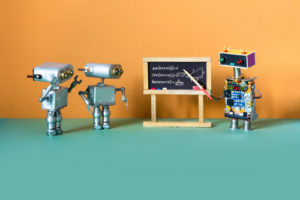
The idea of engaging students in critical thinking, problem-solving, and the engineering design process can feel incredibly intimidating to preservice teachers who feel they don’t have technical skills or a strong background in the sciences. When I give preservice teachers a robot and an assignment to complete with it, they suddenly see that, when they have something hands-on that they can test and experiment with, STEM actually becomes deeply engaging—and even fun and exciting.
There is no better way to help a preservice teacher get excited about STEM than to put them in the role of a student, give them a robot, and then watch them have a blast solving a problem and completing a challenge.
Learning to Secure Classroom Funds
Many of the preservice teachers who take my classes will end up in schools that may not have robotics or the funds to purchase them. As a result, many of my students might be challenged with the prospect of initiating funding for their school.
To help out my students, each semester I spend time teaching how to secure funding, how to write grants, and even how to fight for these kinds of resources within their school or district. How to get the materials they might need for any class is a vitally important lesson for teachers to learn.
How to Differentiate Instruction
Robotics are also perfect tools for practicing differentiation for students. They come in varying complexities and durabilities. In addition to KIBO, I use other robots such as Dash, Ozobots, and Robot Mouse with preservice teachers. One question I always ask my classes whenever I introduce a new type of robotics is how they would use it differently to teach a variety of different grade levels. Some robotics are more durable, making them better suited to younger children, while some take more fine motor skills, suggesting they would work better in a classroom of older students. Preservice teachers always need to have in mind the developmental abilities of the audience for their instruction.
My classes also address the ways the same robotics can be used to address different concepts, subjects, and standards in different grade levels. For example, KIBO has a robot arm that throws objects which is great for teaching forces and motion (a standard that is addressed in NGSS for grade 3) and is also useful for teaching energy, force, and collisions, all of which are a part of the grade 4 NGSS.
Teaching with Passion
Working in pairs or teams of three, the preservice teachers in my classes experience-first hand the challenges and benefits around collaboration and robotics. Collaborating with other preservice teachers gives them a head start in understanding the conflicts and other sticking points their students might encounter when they share robotics, or work in teams on any project, in their future classrooms.
Will there be an argument about who gets to use an important piece like a motor? Will there be a disagreement about the initial design? Moments like these can lead to challenges, but they can also be important learning opportunities. Practicing collaborating in teams with robotics, preservice teachers will learn how to make these conflicts learning opportunities rather than distractions.
Using robotics to elicit excitement, engagement, and motivation to learn gives preservice teachers the tools they need to succeed in their future classrooms. My goal is for these preservice teachers to begin their careers with the understanding and confidence to try new things and learn that if they are passionate about what they are teaching, they can use these important teaching skills to create lessons for any subject that produce the same enthusiasm, collaboration, and engagement they felt when they were using robotics in my class.

Katherine Blagden, previously an elementary STEM educator, received a Masters in Science Education and is currently teaching at Roger Williams University while pursuing a PhD in Education. She can be reached at katherine.blagden@gmail.com.
- Graduates and employers differ on career preparedness - October 14, 2026
- How higher ed can fight fraud without collecting more student data - October 12, 2026
- 5 leadership priorities to become AI-ready - October 9, 2026