
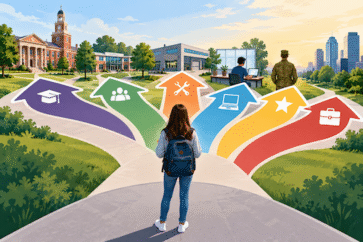
College was the default answer, but the data says it’s time to ask better questions
A better question may focus on what education or training pathway offers the best opportunity based on key variables
Over more than 25 years working in education and edtech, I’ve heard countless questions and concerns about education and career decisions. I’ve also watched the options available to students and workers change considerably.
Top Stories
The most advantaged students attend the best-funded colleges. Does it have to be this way?

The prevailing philosophy of American higher education is simple enough: The best-funded universities ought to be reserved for the best-qualified students, who are largely from advantaged backgrounds.
Expect the unexpected: Lessons learned from conducting online survey research

Online surveys have become one of the most widely used tools in educational and social science research because they provide access to geographically dispersed populations, reduce data collection costs, and allow researchers to gather substantial amounts of information quickly.
Here’s what happens when colleges make the SAT optional

Debating the value of the SAT is something of an American pastime. The latest kerfuffle is happening at the University of California, a massive system that no longer considers test scores in college admissions after critics raised concerns that tests limit opportunities for disadvantaged students.
What small models teach

While investigating how to responsibly deploy generative AI at Haverford College, I have moved parts of my own AI workflow off commercial cloud platforms onto local hardware—my phone, work laptop, and an older desktop with a used graphics card. What began as an experiment has reshaped how I think about AI.
Graduates and employers differ on career preparedness

New data from Cengage’s 2026 Graduate Employability Report finds the connection between education and employment is changing as rising employer expectations redefine what it means to be career-ready.
How higher ed can fight fraud without collecting more student data

As students settle into the academic year, colleges and universities are managing a growing identity challenge that extends far beyond enrollment.
5 leadership priorities to become AI-ready

Four years after ChatGPT changed the conversation around AI, many higher education institutions are still asking how they should adopt AI. A more useful question is whether their systems, data, and people are ready to support it.
Learner agency comes first in AI-driven digital literacy

For many schools, the path to AI literacy remains unclear. The challenge is not simply AI’s rapid evolution, but its ability to generate answers almost instantly, forcing educators to reconsider how learning is guided and measured.

Sponsored Content
The Visual Edge: How High-Impact Technology Redefines Campus Differentiation and Enrollment Strategy

In the current higher education landscape, waning enrollment is still a present challenge. While overall enrollment numbers are showing signs of a rebound, National Student Clearinghouse Research Center data indicates that undergraduate enrollment has yet to fully return to pre-pandemic levels.