
The academic potential of esports
Esports has been around since the advent of early video games and home consoles that rose to fame in the 1980s and 1990s. The first competitive video game tournament occurred at Stanford University in 1972 with a Spacewar battle. Today, games can range from one-on-one play to multiplayer teams within a competitive setting, such as a live arena or streamed to a larger audience.
More recently, esports has risen from a subculture to the mainstream and is now recognized as a profession where players can become legitimate athletes and even celebrities with millions of followers. This recognition has shifted institutions into including esports in academic programs and establishing training facilities to drive recruitment. Even at the casual level, esports is often cited as one of the safest models for learning team collaboration and communication skills.
Designing campus gaming arenas and training facilities
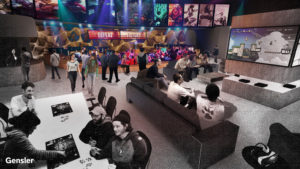
Esports facilities are places where gamers can hone their craft with their teammates and increase player performance. These spaces must be able to accommodate various types of collegiate players and team sizes, while also encouraging camaraderie and community through lounge spaces or designated spectator areas to watch competitions, socialize, and decompress. A gamer’s performance relies on the individual’s mental and physical health, which is why training spaces should be designed with a deep understanding of player needs, such as state-of-the-art gaming equipment, proper ergonomics to create a more comfortable gaming experience, and amenities like a communal kitchen with healthy food options. Training facilities are more than just spaces to practice or compete; they should be able to foster the rehabilitation and rejuvenation of the player.
Because players may have a large fanbase—and sometimes millions of followers via streaming sites like Twitch and YouTube—training facilities also need to include a broadcast space for the shoutcaster, or commentators who highlight the in-game action. In addition, gaming environments need to provide spectators with the same level of engagement as the players in order to make them feel like active participants within the game. This could be achieved through the seating configuration, the size and location of viewing screens, or theatrical lighting and effects that elevate the competitive atmosphere and add production value.
Currently, several colleges and universities have started using their training facilities to conduct student outreach to potential students that may be the next generation of campus gamers. As more students shift to a virtual learning model and are confronted with the challenges of learning online, esports gaming is poised to set a new standard of the virtual learning model and will only increase in popularity when students return to campus.

This content originally appeared on Gensler’s Dialogue Blog and is reposted here with permission.
As Gensler’s Gaming Leader, Derek Sola plays a critical role in high-profile projects for international gaming operators, including MGM Resorts International, Las Vegas Sands Corporation, Caesars Entertainment, and Holland Casino. Planning and conceptualizing integrated resorts as Design Director for Gensler’s Las Vegas office, Derek has a penchant for providing innovative design solutions that result in the greatest end-user impact. Contact him at Derek_Sola@gensler.com.
- Preparing with confidence: Reflections on the dissertation proposal defense - September 18, 2026
- Beyond the gotcha game: Moving from AI detection to verification-first supports stronger academic integrity - September 16, 2026
- Choose encouragement before negativity sets the tone - September 11, 2026