
Key points:
- Campus design should align with how students actually function when the stakes are high
- 6 things to know about the student experience today
- How to meet the needs of the “new majority learners” on campus
- For more news on student success, visit eCN’s Student Success & Well-Being
Finals week is often treated as a question of whether there is enough study space on campus. Are there enough quiet seats, extended library hours, and places to concentrate? The assumption is that students will perform at their best if so. But what that misses is how differently students actually operate under pressure.
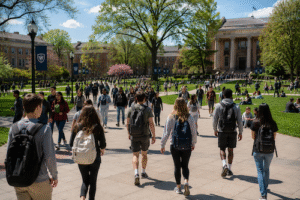
During finals, the campus doesn’t become quieter or more controlled. It actually becomes more active and fluid, relying on a range of environments working together. You will see students constantly move between spaces, adjusting not just where they work but also how they work, based on energy, stress, and focus.
The experience of finals week is shaped less by any single space and more by how the entire campus supports that movement.
Focus is not continuous
There is a tendency to design for sustained concentration, but finals week rarely looks like that in practice. Students cycle through periods of focus, fatigue, distraction, and reset, often multiple times in a single day.
The students who manage that cycle effectively tend to perform better. Not because they put in more hours, but because they know when to step away and come back with more focus.
That behavior is evident in studio-based disciplines. When I was teaching at Ohio State, final reviews made the contrast obvious. Some students came in prepared, rested, and able to clearly communicate their ideas. Others had worked for days without sleep, and it showed. They struggled to present their work, even when the underlying ideas were strong.
The difference was not effort. It was the ability to take care of themselves throughout the process. Campus environments either support that balance or work against it.
Movement is part of the process
Changing environments gives students a way to reset, which often makes it easier to refocus and keep working. The campuses that work best during finals are the ones that make that movement easy. They offer a range of spaces that are intuitive to navigate and allow students to shift how they work throughout the day.
That movement is not limited to the campus core. At Ohio State, the development of the 15th & High District extends this pattern beyond The Oval, creating a natural flow from academic spaces into retail, dining, and residential environments. Pedestrian pathways pull students across High Street and into a broader network of places to study, meet, and recharge, which blurs the line between campus and community.
Informal environments play a significant role in that mix. Lounges, dining areas, circulation zones, and open commons are often used as study spaces, even though they were not designed for that purpose. What they offer is flexibility. Students can work independently, sit alongside others, or take short breaks without fully disengaging.
That flexibility becomes more valuable than any single “ideal” study condition.
Beyond the library
Another shift that is becoming more visible on campuses is the role of recreation and wellness spaces during high-pressure periods. Student recreation centers, which have become a major focus of campus investment, function as part of the academic ecosystem. Physical activity, stress relief, and mental reset all contribute directly to a student’s ability to return to focused work.
At the University of Pittsburgh, a recently completed recreation facility takes this idea a step further. The building is organized vertically, with each level offering a different energy level. The lower floors are active and social, filled with movement and noise. As you move up through the building, the atmosphere gradually shifts, becoming quieter and more reflective, culminating in a rooftop space designed for calm and recovery.
It mirrors the way libraries have traditionally been structured but applied to wellness. The result is an environment that allows students to choose what they need in the moment, rather than forcing a single mode of use.
That kind of design recognizes that focus depends on how well students can manage their energy, not just eliminate distractions.
Supporting the full student experience
Finals week also brings out another layer of campus life that is often overlooked in design conversations.
Many universities, particularly those with a faith-based mission, incorporate moments of reflection, prayer, or spiritual support into the academic calendar during high-stress periods. These spaces offer a different kind of reset, one that is less about productivity and more about perspective.
At the same time, student life programming becomes more visible. Residence halls and campus organizations host small events, whether that is a late-night food station or a simple social gathering, to give students a break and maintain a sense of community.
Designing for what actually happens
Finals week makes it clear that student performance is shaped by more than a single condition. It reflects how well students transition between work and recovery throughout the day.
Supporting that requires a campus made up of interconnected environments. Academic buildings, housing, and recreation spaces all influence how students move through their day. When these spaces work together, students can stay engaged without losing momentum. When they do not, students are left to compensate on their own, often at the expense of their well-being.
The focus should be on building a system that aligns with how students actually function when the stakes are high, rather than centering everything around a single idea of study space.
Finals week does not introduce new behaviors. It brings existing patterns into sharper focus. Campuses that recognize and support those patterns are better positioned to improve performance over time.

Chris Meyers is the Principal Architect and Founder of Meyers + Associates.
- Why AI doesn’t replace education—it demands it - October 2, 2026
- Your institution’s website should prioritize prospective students - September 30, 2026
- Stop trying to AI-proof your assignments - September 25, 2026