
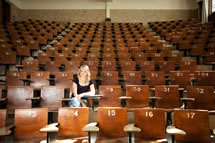
The idea of designing new spaces began by listening to students, say innovative universities, who today often complain that the lecture hall is not conducive to collaboration.
In a study conducted by Steelcase at four U.S. universities, in collaboration with academic researchers from the U.S. and Canada, students who took classes in an active learning environment felt “that the new classrooms contributed to higher engagement, the expectation of better grades, more motivation and more creativity.”
Researchers observed twelve different factors during their study of students in traditional classrooms versus students in active learning classrooms arranged by Steelcase, which included collaboration, active involvement, opportunity to engage and physical movement.
According to the report “a large majority of students self-reported a moderate to exceptional increase in their engagement (84 percent), ability to achieve a higher grade (72 percent), motivation to attend class (72 percent), and ability to be creative (77 percent).”
“I prefer to work in groups while in class instead of only being lectured because you can get input on problems from a diverse group of people,” said Trevor Lazicky, a freshman majoring in early childhood education at Rowan University, New Jersey.
Students like Lazicky are not uncommon, according to Meneely, who said the majority of his students have embraced the new spaces designed by Steelcase at the University of Florida.
“Static or fixed furniture — where it is all lined up in rows,” does not facilitate active learning said Sean Corcorran, General Manager of Education Solutions at Steelcase . “If a teacher really wants to employ multiple pedagogies it becomes very difficult to switch teaching modes. We found that the traditional classroom really gets in the way of all of those different modes.”
One chair developed by Steelcase, called Node, features a built-in desk surface, wheels and a swivel seat, which allows instructors to rearrange their classroom for group discussions or collaborative learning. The chair, which is a popular product according to Corcorran, allows students to maintain sightlines with the instructor, white board, and other students no matter how the room is arranged.
“Normally in standard lecture hall, people just recline back” Meneely said. “In the new environment people are paying more attention. The other thing I see is you don’t have students checking out and reading Facebook as much because the teacher is out on the floor with the students.”
(Next page: Tangible results)

- So, you want to be a school administrator? - November 4, 2026
- 5 best practices for building a university-wide model for online enrollment growth - November 2, 2026
- The data retention challenge for online exam platforms - October 28, 2026