
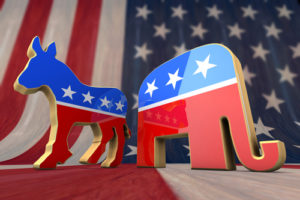
They fall in line with the more Republican worldview, Poulin said, that the private sector can solve problems better than the public sector — and the rise of massive open online courses (MOOCs) has led to a bevy of free or low-cost courses coming from inside the for-profit world.
“Liberals tend to be more suspicious of the profit motive of education,” said Richard Kahlenberg, a senior fellow at progressive think tank the Century Foundation. “Where as Republicans tend to come at this with a pro-market bias and think more competition is better.”
When Newt Gingrich taught a MOOC at the 2012 Republican National Convention, he didn’t choose the popular nonprofit platform edX to host the course. The former House leader instead picked the lesser-known KAPx platform, created by the for-profit education giant Kaplan, Inc.
Earlier this month, speaking at Miami-Dade College, Republican senator Marco Rubio called for states to consider accrediting free online courses, like MOOCs.
“Why hasn’t our education system found a way to harness free online learning and allow it to count toward a person’s post-secondary education?” Rubio asked. “The answer is that we have a broken accreditation system that favors established institutions while blocking out new, innovative, and more affordable competitors.”
Private companies offering a cheaper, more accessible alternative to a public education — what more could Republicans ask for? Better learning outcomes for one, some skeptics argue.
Fully online programs have been heavily criticized for their low rates of completion.
Many Democrats have taken a more hybrid-friendly approach, looking for solutions to come from within traditional public institutions that generally sport better retention rates.
Even this approach might have less to do with proven results and more to do with a political bias, Poulin said.
- What does higher-ed look like in 2023? - January 5, 2015
- Are ed-tech startups a bubble that’s ready to burst? - January 1, 2015
- Are MOOCs really dead? - August 28, 2014