
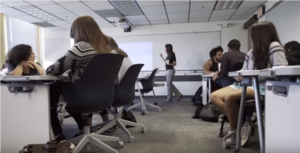
The Collaborative Learning Space (CLS)
As faculty redesigned lessons to include shorter lectures, movement, and activities to promote higher-order thinking, it became clear old lecture halls did not support this style.
As a solution, we built a large Collaborative Learning Space (CLS). Its emphasis on high quality mobile furniture and integration of tabletop whiteboards created an environment where students could more easily interact with each other.
Re-energized, faculty across campus began seeking out opportunities to teach in our CSL. They tried new strategies they had never been able to successfully implement. They found new joy in teaching which in turn ignited students with a passion for learning. This change in culture has helped build campus-wide enthusiasm.
Throughout this evolution, assessment has been essential. Evidence from a 1998 study on classroom learning and assessment shows that students who receive frequent and prompt feedback learn better. We provide support and guidance for faculty about ways to conduct effective assessments throughout their courses. These provide the evidence we use to evaluate the impact of change.
They also allow faculty to contribute to the evidence-based teaching and learning knowledge base. As they become comfortable and see results, they become vocal advocates of evidence-based teaching.
Seeing Results
Faculty interest in evidence-based learning continues to grow on our campus. Educators are excited to teach in active learning spaces and collaborate with like-minded colleagues in FLCs. They hope for better student outcomes and the chance to use new pedagogy that was not well-supported when they were teaching in a traditional classroom space. There is momentum around our evidence-based learning initiative that promises to be transformative.
During the CLS’ first year, it saw 10,000+ enrollments and 80 different faculty from 40 departments benefitted from teaching in the space. As a result, we made a commitment to shift our culture from one that accepts lecture-based teaching as the norm to one that embraces collaborative learning.
By Fall 2017, twenty CLSs, ranging in size from 24 students to 264 students, are serving 210 faculty from sixty departments.
We’re thankful to the AAU who awarded UA and seven other universities a grant to improve undergraduate STEM Education. In the following year, UA was one of 12 schools awarded an active learning classroom through the Steelcase Education Active Learning Center (ALC) program. There is no doubt that these awards spurred our campus-wide innovation.
Our leadership team, often referred to as the “coalition of the willing,” established a vision for change. They eliminated barriers that might discourage the adoption of change and inspired a broad and diverse group of faculty members to embrace change and help institutionalize new strategies. Our culture is evolving and we look forward to the positive impact this movement will continue to have on student learning.

Dr. Jane Hunter is the director of Academic Resources & Special Projects at the University of Arizona. Her primary focus is the implementation of programs and initiatives to help faculty become more effective instructors and students become better learners. She oversees the UA Learning Initiative which is an approved Higher Learning Commission (HLC) Quality Initiative designed to enhance and support student learning through integrated programs for both faculty and students.She also plays an instrumental role in efforts to transform existing campus spaces into Collaborative Learning Spaces.
- 5 leadership priorities to become AI-ready - October 9, 2026
- Learner agency comes first in AI-driven digital literacy - October 7, 2026
- Authority, responsibility, and accountability for AI in higher ed - October 5, 2026