
Key points:
- When it comes to AI, the next great debate will focus on if universities are willing to host the engines that powers them
- Aligning AI with pedagogy, privacy, and outcomes
- Redefining the role of faculty and AI in higher education
- For more news on higher-ed AI, visit eCN’s AI in Education hub
Higher education has spent the last two years debating whether students should be allowed to use artificial intelligence. That debate now looks almost quaint. The more urgent question is whether colleges and universities will help build the physical infrastructure that makes AI possible. Behind every chatbot, predictive advising platform, research model, automated tutoring system, and administrative dashboard sits a hard industrial fact: AI does not float in the cloud; it lives in data centers, consumes electricity, requires cooling, occupies land, and provokes public resistance.
What a data center really is
A data center is a specialized facility that houses servers, storage systems, networking equipment, backup power systems, and cooling infrastructure. The International Energy Agency explained that AI training and deployment occur largely inside these facilities, where servers and accelerated processors such as GPUs process enormous volumes of data. These buildings are not simply warehouses with computers inside. They are high-density, energy-intensive digital factories that make modern AI possible.
The scale of this buildout is staggering. The International Energy Agency projected that global electricity consumption from data centers could double to roughly 945 terawatt-hours by 2030, with AI-driven accelerated servers becoming a major source of that growth. That number matters because higher education is not a bystander in this transformation. Universities are among the most aggressive users of AI for research, teaching, health care, cybersecurity, student success, institutional analytics, and workforce development.
Yet the public is increasingly unwilling to host this infrastructure. Gallup’s March 2026 survey found that seven in 10 Americans oppose the construction of AI data centers in their local area, including nearly half who strongly oppose them. Residents are raising concerns about electricity demand, water use, noise, backup generators, local utility costs, and the feeling that communities are being asked to absorb the burden while distant technology companies capture the benefit. That resistance is not hypothetical; it is becoming a political force.
The campus opportunity
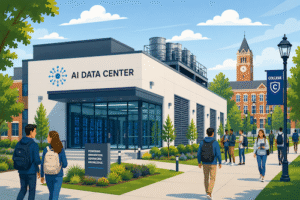
This is where higher education may have an opening that technology companies do not. Many colleges and universities own land, control campus planning, operate near utility infrastructure, and already possess public legitimacy as research, workforce, and civic institutions. They also need new revenue streams at a time when enrollment volatility, state funding pressures, deferred maintenance, and rising technology costs are reshaping institutional finance. A campus-based data center partnership, if governed responsibly, could convert unused or underused institutional land into long-term income while expanding AI access for students and faculty.
Early examples are already appearing. Oakland University is exploring an AI Institute and Data Center that would be built by a private developer in partnership with the university, with shared use by the institution and selected industry partners. The university states that revenue from the project would support university operations and initiatives, while the facility would broaden academic programming, research, student engagement, and internship opportunities. That model is important because it frames the data center not merely as a real estate transaction, but as an academic infrastructure strategy.
The University of Michigan and Los Alamos National Laboratory are planning a new research computing center in Ypsilanti Township to strengthen computing capacity, accelerate discovery, and support work in artificial intelligence, physics, engineering, energy, medicine, and national security. This example also shows the difficulty of the issue. When a university-backed computing project moves beyond campus boundaries, local questions about transparency, energy, water, land, and community benefit become unavoidable.
The financial logic is significant, although institutions must be careful not to overpromise. Commercial AI data center leases can be massive; Hut 8 announced a 15-year, $9.8 billion lease for 352 megawatts of AI data center capacity in Texas, illustrating the scale of the current market. A university would not necessarily capture revenue at that level, especially if it leases land rather than owns and operates the facility. However, even a modest ground lease, shared-use agreement, utility partnership, research allocation, or workforce-development package could create a recurring revenue stream that many institutions badly need.
The mission alignment is also real. If AI is becoming part of every discipline, then access to advanced computing power is becoming part of educational equity. Universities that cannot afford commercial cloud costs will struggle to train students, support faculty research, and compete for grants. Campus-linked data centers could support AI literacy, engineering programs, health research, climate modeling, cybersecurity education, digital humanities, and regional workforce development. In that sense, advanced computing capacity may become as central to the 21st-century university as libraries, laboratories, and broadband were to earlier eras.
Governance before growth
But this opportunity comes with a warning label. Universities cannot present themselves as public-serving institutions while quietly importing the worst habits of the technology sector. Any campus data center proposal should include transparent governance, public utility analysis, water-use disclosure, community benefit agreements, student and faculty access provisions, sustainability standards, local workforce commitments, and independent environmental review. The institution must be able to answer a simple question before construction begins: Who benefits, who pays, and who bears the risk?
The hard truth is that AI infrastructure will be built somewhere. If higher education refuses to engage, the buildout will remain largely in the hands of private developers whose primary obligation is to investors, not students, communities, or public knowledge. If colleges and universities engage carelessly, they will inherit the backlash now facing technology companies across the country. However, if they engage with courage, transparency, and mission discipline, they could transform data centers from feared industrial intrusions into governed academic infrastructure.
The next great campus debate will not be about whether AI belongs in the classroom. It will be about whether the university is willing to host the engine that powers it. Higher education can either watch the AI infrastructure economy rise around it, or it can insist that the backbone of artificial intelligence serves learning, research, equity, and the public good. The window is open now, but it will not stay open for long.

- When AI’s architects ask to slow down, education must speak up - September 28, 2026
- Stop calling every misuse of AI plagiarism - August 19, 2026
- Accreditation’s AI reckoning: Can colleges still prove students are learning? - July 29, 2026