

Online learning is still in what Dr. Alexander refers to as a first-level technological paradigm. We are largely adapting “traditional” classes, not restructuring instruction. Our mental model starts with, “How do I teach my ‘regular’ class online?” This kind of question implies that we are still in the “horseless carriage“ mode of understanding how technology will change instruction.
The result is a very uneven learning environment in the online sphere. Some functions, such as content distribution, are well-provided for, while others, such as tools for sharing, are not as effectively supported, leading to a bias toward the what Seymour Papert and Idit Harel referred to as the Intructionalist mode of teaching over more Constructionist approaches. Those populations who have been well trained in the consumption of content and its regurgitation do well. Those with poor learning skills or those who seek deeper understanding of the topic are often left frustrated, isolated and disconnected.
This also raises deep qualitative versus quantitative questions. If we are content to measure success with grades over achievement the results look good. If, however, we wish to achieve lasting, deeper learning we must examine what is going in both physical and virtual spaces and develop appropriate tools to meet the challenges of achieving authentic teaching and learning.
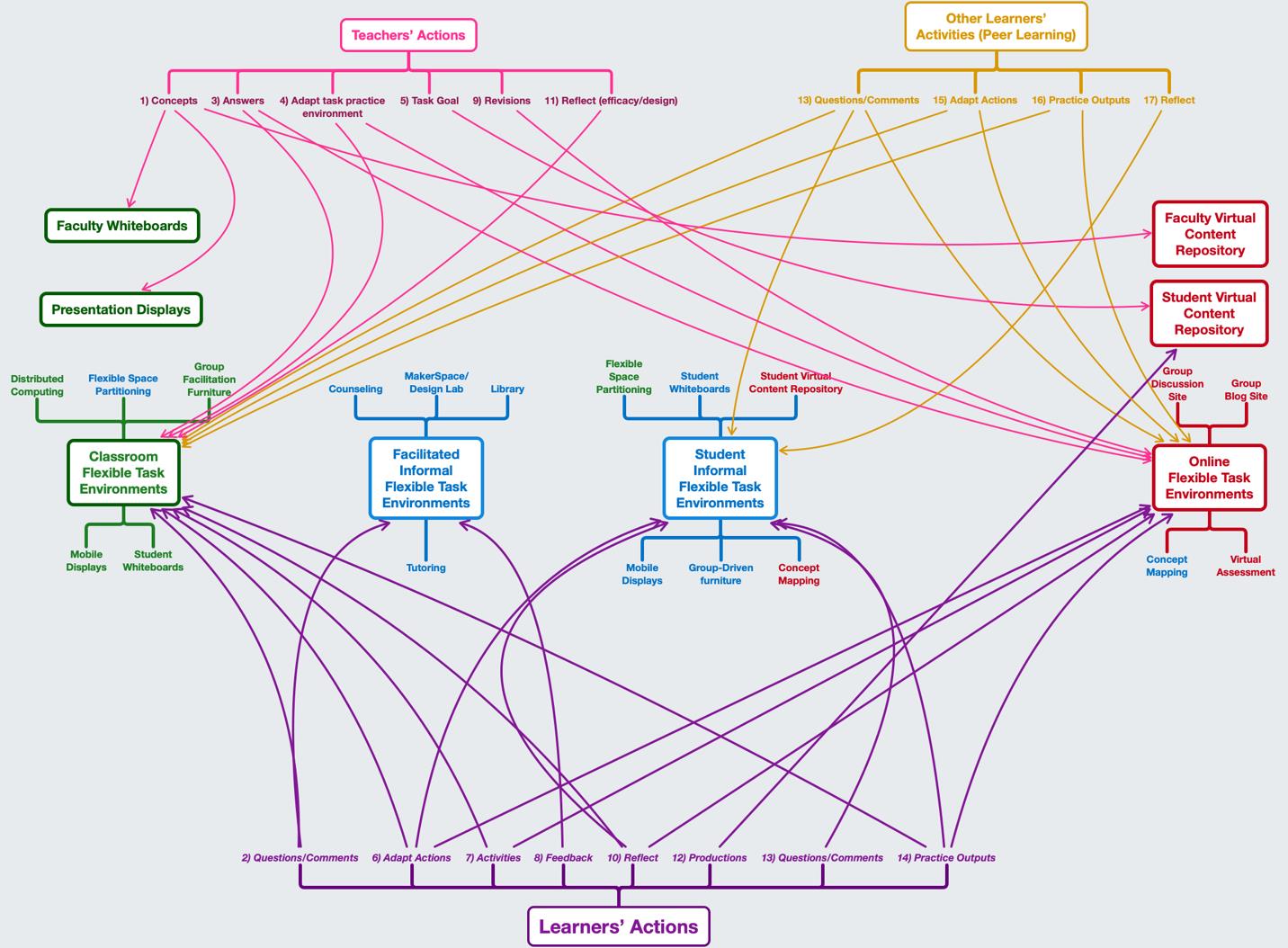
Using an approach based on Diana Laurillard’s Conversational Frameworks, the one thing that immediately jumps out is that learning requires a broad set of tools to be effective. However, one common theme, both in-person and online, is a need for flexible task environments that augment learning conversations. Properly-designed hybrid instruction (partially online and partially in-person) gives both teacher and learner access to the widest range of complementary tools. Online instruction offers persistence and repetition difficult to achieve within the temporal and physical constraints of a traditional classroom. Physical environments, and the people who inhabit them, provide a level of human interaction and immediacy of response difficult to replicate virtually. Effective hybrid instruction should combine the best of both.
However, hybrid classes suffer from the same technological blinders as fully online classes (“How do I teach half my ‘regular’ class online?”). When hybrid works, it can be very effective, but I believe the relative scarcity of hybrid classes is because to do them effectively requires a total deconstruction of the activities in a class, followed by an adaptation of them to the appropriate modalities of physical and online paradigms. This is challenging and forces the teacher to closely examine the modalities of his or her instruction. Mapping instruction onto Laurillard’s framework may provide an easier pathway to deconstructing instruction.
This is only half the challenge, however. Deep analysis of how courses are being taught in the online/hybrid environment will quickly lead to the conclusion that physical environments will also have to adapt to better meet the needs of asynchronous students. One strategy is to view hybrid classes as online classes with physical support, instead of vice versa. This will help both faculty and institutions develop second-order technological approaches, because it forces them to work backwards to the first paradigm. Some for-profit institutions such as Strayer and the University of Phoenix that are heavily dependent on online instruction are already doing this and starting to build specially-designed physical spaces to support their online students.
A systematic, learner-centric approach leads us to logical conclusions about how both online and physical learning environments should adapt to support hybrid instruction. For instance, spaces where faculty can meet with varying groups of hybrid students at irregular intervals should be part of the physical design and management of campuses supporting hybrid students.
Furthermore, augmenting informal support for teaching and learning, such as tutoring, counseling, making, and library services, will better support students who benefit from the asynchronous nature of online learning but struggle with learning outcomes absent the physical mentorship of college personnel.
Meeting the needs of all students requires the proper application of technology and also an understanding of human nature. It is easy to imagine a landscape where all courses are “hybrid” but plotting a course to get there will remain a challenge. We must engage in an ongoing conversation about how technology reshapes instruction.
Learning is a difficult process and the mental, physical, and virtual tools available to both the teacher and learner must be aligned around augmenting human learning, not administrative convenience. Digital technology gives us the ability to achieve that.

Tom Haymes is a technologist, photographer, teacher, social scientist, project manager, and educational technology leader. He was design lead for Houston Community College’s West Houston Institute and is author of the forthcoming book Discovering Digital Humanity (ATBOSH Media). His website is ideaspaces.net and he tweets at @ideaspacesnet.
- Can high-tech scale high-touch? - September 4, 2026
- Your institution’s AI strategy needs instructional designers - September 2, 2026
- The hidden link between AI strategy and student retention - August 31, 2026