

Optimizing for memory
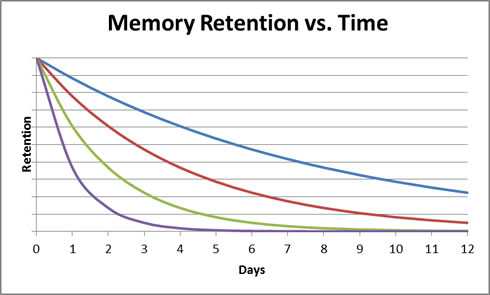
These concepts are related to the notion of spaced repetition. Rather than bingeing on information (for instance, pulling an all-nighter before an exam), students should study a little each day or every other day to refresh the information on a consistent basis. Without this rehearsal of knowledge, memory retention drops over time.
Certain types of knowledge may naturally have longer retention, such as mnemonics, rhymes, acronyms (blue line below) as opposed to random strings of digits and letters (purple line). Knowledge that is practiced can gradually move from quickly decaying (purple) to longer-lived (green, red, blue) through practice. This repeated practice explains how a person can remember certain random strings of information such as a locker combination, identification numbers, or license plate.
Order and structure can also help with retention. Rather than remembering dozens of formulas, one can learn the principle behind them, which is easier to remember for longer periods of time.
Practices for efficiency
With the importance of frequency established, the next step is to determine what students should be doing during these regular study sessions. Many instructors have found learning benefits by utilizing the method of frequent, low-stakes testing.
Low-stakes testing can be any sort of assessment that doesn’t have a large impact on final grades, unlike an exam that could make up 10-25 percent of the final grade. With frequent, low-stakes assessments, students get regular feedback that helps guide their studying and expectantly makes them more effective and efficient studiers.
This also helps preclude a misconception that simply reading the text or notes is sufficient – active use of the information in the context of a problem is key.
So, as an educator, how do you facilitate this behavior? Rather than assign weekly homework or homework limited to the days on which class meets, you can use online assessment tools to provide more frequent assignments designed to improve studying and retention.
(Next page: Online assessments are the new workouts)
- 25 education trends for 2018 - January 1, 2018
- IT #1: 6 essential technologies on the higher ed horizon - December 27, 2017
- #3: 3 big ways today’s college students are different from just a decade ago - December 27, 2017