

As educational technology becomes more prevalent in higher education, administrators are hoping to improve student outcomes, boost their school’s visibility and prestige, and aid in student recruitment and retention. Here’s how four institutions are doing just that.
1. Rhodes College (Memphis, Tenn.)
Here’s what Robert M. Johnson, Jr., vice president of student and information services and chief information officer, had to say:
“Rhodes College has used digital assets management technology to make its educational ‘footprint’ much larger than one would expect from a college smaller than 2,000 students. Rhodes has used Fedora and DSpace, both open-source digital asset management systems, to provide access and preservation options for documents, images, video, datasets, maps, and audio files.
“Fedora is the backend software for Rhodes College’s Crossroads to Freedom, which houses student and community collaborative projects.
“Additionally, based on an aggregation of scores related to the size, visibility, number of ‘rich files,’ and scholarship potential, the D-Space installation, a repository named DLynx, is ranked No. 80 in the United States and No. 407 internationally, according to The Ranking Web of Repositories.”

2. Utah State University (Logan, Utah)
Here’s what Chief Information Officer Eric Hawley had to say:
“One of our most recent innovations is Cloud Enabled Classroom Review (a.k.a. Classroom Capture).
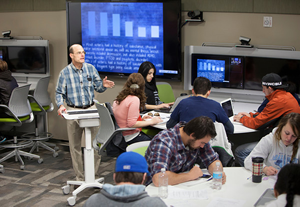
“Notes? Nah! Get note taking out of the way. How about enabling students to review everything, anytime, anywhere—we use PANOPTO [lecture capture technology]! Secondly, we use a conversion of classrooms from analog technology to full digital with brand new CRESTRON controllers and interfaces. Third, Utah State University has collaborated with classroom furniture companies IZZY+ and STEELCASE to develop the first-ever intelligent classroom design for interactive technology instruction. The classrooms, also known as ‘PODS,’ are designed to facilitate collaborative discussion among the students by offering a multitude of conferencing options—thus creating a richer opportunity for geographically diverse interaction.”
3. University of California, Hastings College of the Law (San Francisco, Calif.)
Chief Information Officer Jake Hornsby:
“I started my role in May last year, and at that time the campus did not even have an LMS. Now, with the help of my excellent staff, we have not only the basic tools, e.g. Blackboard, echo360, Adobe Connect, and single sign-on, but [in February, we launched] our first online course, with more in the pipeline—an impossible rate of change for a law school.
“These initiatives started after May 2012, to give a perspective on how quickly employees had to adapt. Even worse, this is after a downsizing effort which removed 15 percent or so of the IT workforce.
“I recently moved to the UC system from the University of Cambridge (UK) as the head of IT there, and thus I come from a ‘build’ and not a ‘buy’ world. However, things have changed, especially in financially-strapped schools like UC. We must continue to find strategies for reducing administrative overhead, while … pushing toward what matters the most: teaching, learning, and research. Nothing else in a school is as important as those things, but all functions are still needed to achieve excellence in those areas. It is so easy be caught up (as a CIO) in endless discussions concerning finance and other such systems, and we can lose site of what we do any of this for.”

4. Mitchell Technical Institute (Mitchell, S.D.)
Chief Information Officer Dan Muck:
“Over the past year, we have implemented many software solutions to help students learn. Our major project was the implementation of a new SIS and LMS. We chose the Jenzabar EX solution and have had great success with the E-racer LMS platform. Faculty, students, and support personnel have many positive comments, and learning is now delivered on-demand.
Additional software packages we have been able to implement because of the new LMS include Smarthinking online tutoring, VoiceThread for unique lecture capture and student discussions, Softchalk used to develop interactive engaging learning activities, and SonicWall Content Filter to reduce malware, advertisements, etc., which interfere with student learning.

Follow Assistant Editor Sarah Langmead on Twitter at @eCN_Sarah.
- Adaptive learning helps personalize instruction for students - March 29, 2013
- New software aims to improve course evaluation process - March 27, 2013
- Disability Resource Center empowers students to unlock their full potential - March 25, 2013