
Key points:
- Graduate medical education still lacks the centralized application infrastructure that transformed medical school admissions
- Why the old enrollment playbook no longer works
- This is the last “old” college admissions cycle
- For more news on centralized admissions, visit eCN’s Campus Leadership hub
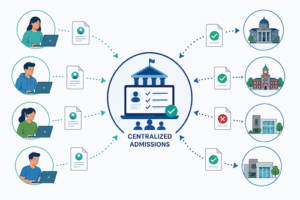
Centralized application services transformed how students apply to medical school. They gave applicants a single point of entry, standardized how programs receive and review data, and provided comparable information institutions could actually use. Graduate medical education has not had the same evolution.
Residency and fellowship applicants still navigate a fragmented system. The visible costs are financial. Application fees accumulate quickly across a competitive applicant pool, and interview travel expenses compound the burden, particularly for candidates without institutional support or flexible work arrangements.
The less visible costs are just as consequential. Applicants spend significant time on duplicative data entry across noninteroperable portals, reformatting the same materials to meet program-specific requirements. Many have limited visibility into where they stand in the review process, and inconsistent requirements mean the goalposts shift with every application. For applicants without strong advising networks, that opacity compounds the uncertainty at an already high-stakes moment.
Coordinators carry a parallel burden. Manual data collection, format reconciliation, and tracking across disparate timelines demand substantial staff time. Program-specific data silos limit benchmarking and cross-program analytics. When systems don’t communicate cleanly, errors follow, including missed documents, inconsistent credentialing records, and compliance exposure.
None of this is inevitable.
What graduate medical education can learn–and where analogies break down
The American Medical College Application Service (AMCAS) and the American Association of Colleges of Osteopathic Medicine Application Service (AACOMAS) demonstrate that standardization at scale can reduce duplication, streamline coordinator workflows, and give both applicants and programs a more reliable process. A unified data schema–standardized transcripts, test scores, licensure records, and letters of recommendation–reduces redundancy and the error rate that comes with it. Batch communications, real-time status updates, and consistent timelines are all achievable once the infrastructure is shared.
Equity gains are harder to quantify but worth naming directly. Standardized, predictable processes lower hidden costs that fall hardest on applicants with fewer resources. Centralized platforms can collect demographic and need-based data in ways that support targeted outreach, application fee relief, and interview support. Uniform data presentation makes it easier for programs to evaluate candidates against common criteria rather than against the quality of their advising. And because centralized pipelines consolidate data that is currently scattered across systems, they make it possible to monitor equity gaps over time and build in accountability mechanisms to address them.
That potential comes with genuine constraints, though. Graduate medical education spans a wide range of specialties, each with distinct credentialing requirements, rotation structures, and board standards. A platform that works for internal medicine residencies has to accommodate fellowship programs with substantially different operational rules.
Unlike MD and DO admissions, residency and fellowship applications are directly tied to employment, licensing, and patient care, a regulatory and operational complexity that undergraduate medical education admissions don’t carry. Legacy systems, institutional IT constraints, and deeply embedded local processes make migration more complex than it was when AMCAS and AACOMAS launched.
The resistance isn’t only technical. Specialty societies, program directors, and hospital affiliations have legitimate interests in maintaining control over how they screen and select candidates. Centralization must be designed to support specialty-specific judgment, not replace it.
One of the most persistent tensions in moving toward centralized systems is the deeply held sense of ownership programs feel over their applicants. Even while acknowledging that prospective students are applying broadly, many programs operate as if their pool is uniquely theirs to cultivate and convert. I have seen this most clearly in nursing education, where significant time, budget, and staff effort are invested in recruitment strategies, relationship-building, and applicant nurturing. That investment naturally creates a protective instinct.
The concern is not just philosophical; it is operational. Programs worry that centralization introduces competition in a more immediate and visible way, increasing the risk of “losing” applicants they worked hard to attract. In decentralized environments, there is at least a perception of control over the applicant journey. A shared platform, by contrast, makes applicant behavior more transparent and fluid, which can feel like a loss of influence.
In my experience, addressing this concern requires more than reassurance. It takes sustained dialogue, transparency, and data. Walking through past cycle data, demonstrating application patterns, and showing how centralized systems can actually expand reach rather than dilute it were critical steps in helping programs recalibrate their thinking. Over time, many came to see that centralization does not eliminate competition, but simply makes it more honest and, ideally, more equitable. The shift is less about giving something up and more about adapting to a system that reflects how applicants already behave.
What adoption would actually require
For centralized admissions to gain traction in graduate medical education, it should clear several bars simultaneously.
The value proposition has to be concrete. Program directors and medical associations need to see demonstrated reductions in time to decision, evidence of improved match quality, and a cost-benefit picture that makes the transition worth the disruption. Pilot programs and regional consortia offer the most credible path to generating that evidence.
Flexibility in platform design is nonnegotiable. A modular architecture that accommodates specialty-specific rules, varied interview formats, and institutional preferences will travel further than a rigid one-size-fits-all approach. The goal is shared infrastructure, not uniform process.
Governance matters as much as technology. A credible centralized model requires transparent, multistakeholder governance, with representation from program directors, residency and fellowship councils, medical associations, and learner advocates. That governance structure also has to address funding directly: who administers the platform, how costs are distributed across institutions and associations, and how the model sustains itself without creating a new set of access barriers for smaller or under-resourced programs.
Data privacy cannot be an afterthought. Integration with licensing boards, transcript services, and program accreditation systems means handling sensitive information across multiple regulatory frameworks, such as HIPAA and FERPA. Compliance infrastructure, data minimization practices, consent controls, and audit trails are baseline requirements.
Equity safeguards also need to be built into the platform architecture. Analytics that track diversity, inclusion, and access metrics–with clear accountability for addressing gaps–should be a design requirement from the outset, not a feature request after launch.
Finally, change management support must be prioritized from the start. Staff retraining, phased implementation, and dedicated support resources are the difference between adoption that holds and adoption that stalls.
The human side of adoption
I have seen firsthand that adoption lives or dies with how people experience the change, not how strong the platform is on paper.
What stands out to me in this work is that change management is fundamentally relationship work, not just training. My team and I held a three-month cadence of lunch-and-learns that created space for repetition, questions, and gradual normalization, which is often what hesitant stakeholders actually need. More importantly, our one-on-one engagement with faculty and administrators acknowledged that resistance is usually tied to something specific–control over selection criteria, comfort with existing workflows, or concern about unintended consequences.
By surfacing those “closely held” elements and mapping them to equivalent or improved outcomes in the new system, I was able to shift the conversation from loss to continuity and enhancement. I continued this approach even after adoption. We’d run the numbers from a previous cycle and apply new paradigms to determine if there were opportunities for improvement or just to affirm that we did it right.
This approach aligns directly with what centralized GME adoption would require at scale. Program directors are unlikely to be persuaded by efficiency claims alone; they need to see that their core values–fit, autonomy, and program identity–are preserved or even strengthened. I have found that translating system features into stakeholder-specific benefits is the bridge that makes adoption possible.
It also reinforces a critical point: Phased exposure builds trust. A three-month engagement window signals that adoption is a process, not an event. In the GME context, where stakes and complexity are even higher, this kind of intentional pacing, paired with visible support resources, would likely be the difference between nominal adoption and real behavioral change.
Ultimately, I see change management not just as support, but as shared ownership. When stakeholders see their priorities reflected in the system and feel heard throughout the transition, they are far more willing to move from cautious observers to active participants.
The opportunity in front of the field
Centralized application services did not eliminate complexity in undergraduate medical education. They reorganized it in ways that made the process more navigable for applicants and more manageable for programs. Graduate medical education has an opportunity to do the same, and the existing models provide a meaningful head start.
The infrastructure required for centralization is not hypothetical. The governance and equity challenges are real but solvable. What the field needs now are the institutional relationships and shared will to move from a fragmented status quo toward something that works better for everyone.

Karen Jacobs is Vice President of Account Management at Liaison, where she partners with institutions navigating change in higher education enrollment and admissions. She brings more than two decades of experience in enrollment management, having led admissions operations at Thomas Jefferson University, Penn State Abington, and Jacksonville University.
- Graduates and employers differ on career preparedness - October 14, 2026
- How higher ed can fight fraud without collecting more student data - October 12, 2026
- 5 leadership priorities to become AI-ready - October 9, 2026