
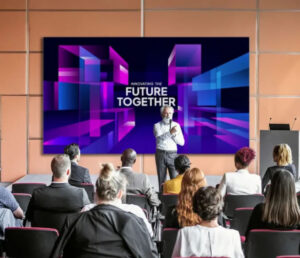
In the current higher education landscape, waning enrollment is still a present challenge. While overall enrollment numbers are showing signs of a rebound, National Student Clearinghouse Research Center data indicates that undergraduate enrollment has yet to fully return to pre-pandemic levels. For IT administrators and tech directors, this shift necessitates a move from being service providers to being strategic partners. To drive growth and retention, institutions must offer a future visualized through a modern, tech-forward campus experience.
One powerful solution in this effort is Direct-View LED (dvLED) technology. By replacing aging projection systems and tiled LCD walls with seamless, high-impact visuals, universities can create the visual impact necessary for campus differentiation.
The Science of First Impressions
The campus visit remains the most influential factor in a prospective student’s decision-making process. When a family walks into a student center or a business school atrium, they look for signs of institutional health and innovation.
Traditional LCD video walls often feel like a relic of the past because of their distracting bezels showing grid lines between screens. dvLED displays provide a seamless canvas instead. Because these displays consist of tiny LEDs that emit light directly, they produce ultra-bright, high-contrast imagery that remains vibrant in bright or high-traffic lobbies. This technology signals to prospective students that your institution is invested in the highest standards of professional technology.
Strategic Use Cases for Campus Differentiation
To maximize ROI, tech directors should view dvLED as a multi-purpose asset that supports recruitment, student life, and academic excellence.
1. Large Space Experience Lobbies and atriums are the primary locations for recruitment tours and often provide more space to accommodate visitors. Schools are increasingly adopting large-scale dvLED video walls to transform these spaces into dynamic event hubs. Whether displaying timely announcements, student achievements, or welcoming high-profile guest speakers, a seamless video wall turns a transition space into a destination.
2. Modernizing the Lecture Experience By replacing standard projectors with high-definition dvLED displays, institutions can eliminate the need to dim the lights. This allows for better eye contact and engagement between faculty and students. When paired with digital podium solutions, these displays allow for a more interactive teaching environment that engages every student in classrooms.
3. Enhancing the First-Year Experience Retention is just as vital as recruitment. Mobile dvLED solutions are units that can be folded, transported in standard elevators, and set up in minutes. These mobile video walls bring high-impact visuals to any event for student events. From athletic rallies to outdoor movie nights or esports tournaments, mobile displays provide a flexible way to boost student belonging and engagement without the permanent construction costs of a fixed installation.
The IT Admin’s Guide: Implementation Dos and Dont’s
For tech directors, the transition to dvLED requires a shift in how we think about maintenance and longevity.
DO prioritize support. Look for solutions that offer support with installation and hot-swappable modules. Because dvLED is modular, a single damaged pixel or panel should not take down the whole display. Having hot swaps ensures your display is never dark.
DO consider the total cost of ownership. While the initial investment in dvLED may be higher than projection, the lifespan is significantly longer and doesn’t require replacing lamps or cleaning filters.
DON’T ignore the “Pixel Pitch”. A common mistake is buying a high-resolution (low pixel pitch) screen for a high-up lobby wall where viewers are 30 feet away. You can often save significant budget by selecting a wider pixel pitch for distant viewing without sacrificing visual quality.
The Vision: A Future-Proof Campus
As institutions like California State University, Fullerton (CSUF) have discovered, moving from traditional LCD or projectors to dvLED is often driven by a need for easier maintenance and superior visual impact. When the hardware fades into the background and only the content remains, the technology has done its job. For the IT administrator, the ROI of dvLED is found in its versatility, whether it’s for recruitment, teaching, or community building. In a competitive enrollment environment, providing a cutting-edge visual experience is a clear signal that your campus is ready for the future.
Content provided by:


- The Visual Edge: How High-Impact Technology Redefines Campus Differentiation and Enrollment Strategy - February 24, 2026
- Changing how two-year colleges prepare students for the world of work - February 18, 2026
- Identifying and overcoming your career-inhibiting fears - February 13, 2026