
Challenge #2; Solution #2
The second challenge is to make the technology transparent enough so that it does not impede the process of instruction. Even an instructor with a great understanding of technology can be thrown off track when asked to divide their attention between the content of instruction and the mechanics of presentation and transmission. It is difficult to be onstage and backstage at the same time.
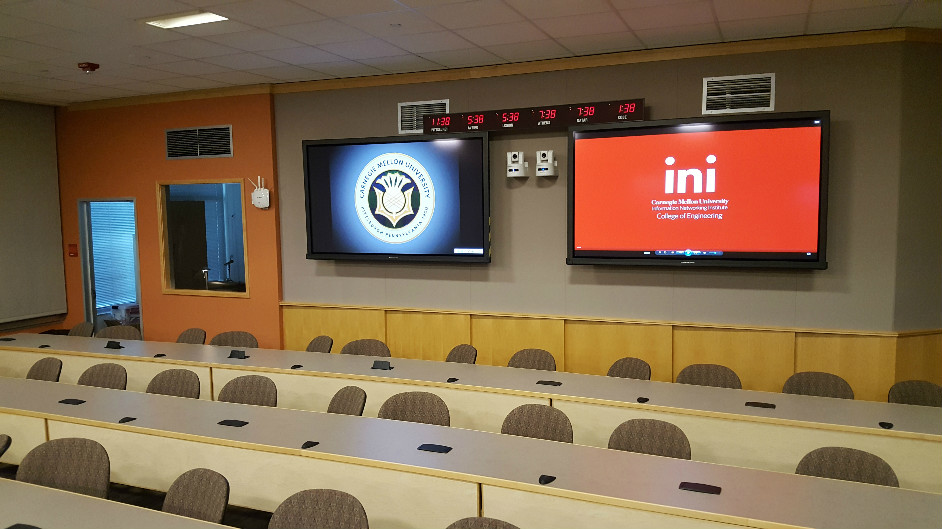
Under the guidance of INI Director Dr. Dena Haritos Tsamitis, the approach taken by the INI in the initial construction and ongoing evolution of its two Distributed Education Classrooms, (DECs), is that of both technical agility and pedagogical fidelity. The goal is to provide supporting technology to allow equivalent interactive opportunity for on- and off-site students as well as maintaining an environment where the technology is largely transparent to the instructor, allowing them to focus on content.
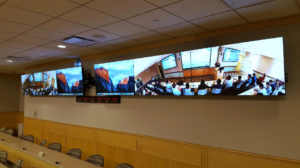
More closely approximating the functional capability of a television production facility than that of a typical technology-enhanced learning space, each DEC employs multiple pan/tilt cameras for instructor and student video feeds and multiple high-resolution displays for presentation of participant video and instructional content. Audio capture is via desktop microphones and return audio by way of a full-room, ceiling mounted speaker array. In both classrooms, audio and video feeds are routed by way of a custom designed control system, which allows for configuration to meet a variety of use cases.
A high degree of technical agility comes at the cost of operational complexity, however. INI’s DECs are staffed with technicians who attend to the technical operation of the facilities, leaving the instructors to instruct. A subset of display controls is available to instructors on a podium mounted touch panel so that they may switch between content sources on the fly if they so choose.
At the time of this writing, new 200-degree camera technology has been adapted for classroom use and is undergoing testing in the INI Henry Street DEC to give a more immersive feel to instructional events shared with CMU’s Silicon Valley Campus. Unlike the view from a grocery bag, the system will allow a panoramic view of the front and rear of the remote classroom. Augmented by traditional camera views of both instructor and individual students, the panoramic perspective will provide a more engaging spatial orientation for students in both classrooms.
As our instructional space becomes more global in nature and our student base more geographically diverse, the goal will continue to be that of maintaining an effective and meaningful connection across distances through the effective use of technology.
 Author Kurt Haverstock will be presenting general conference session E12 at EduComm Expo 2016 entitled, “The Evolving Nature of Distributed Education Classroom Design & Delivery Technologies,” on Wednesday, November 16 from 3:00-3:50pm at Chicago’s Navy Pier. For more information on EduComm Expo 2016, or to register for this or any other educational seminar or workshop and learn more about digital communications technologies and strategies, go to www.educommexpo.com

Kurt Haverstock is manager of Distributed Education Technology & Facilities at Carnegie Mellon University. Haverstock joined the Software Engineering Institute at Carnegie Mellon University to head the video production component of the Video Dissemination Project (VDP) in 1988. VDP was an effort to seed software engineering education programs in Higher Education via synchronous and asynchronous video distribution of classroom instruction. Present at the confluence of computing, video, and resulting instructional technologies and excited by the possibilities, Haverstock earned a M.Ed. in Instructional Design and Technology from Pitt. Thirteen years and couple of stops in instructional asset acquisition and media production later, Haverstock arrived at Carnegie Mellon yet again to manage distributed education classrooms and associated technology for the Information Networking Institute.
- Beyond the gotcha game: Moving from AI detection to verification-first supports stronger academic integrity - September 16, 2026
- Choose encouragement before negativity sets the tone - September 11, 2026
- Building an everyday equitable practice for AI in schools - September 9, 2026