
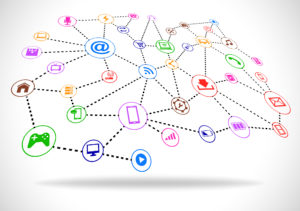
The International Data Corporation forecasts that U.S. organizations will invest more than $232 billion in IoT hardware, software, services, and connectivity this year.
“The education sector is generally not addressing [the IoT] at all,” said PK Agarwal, regional dean of Northeastern University-Silicon Valley. Aside from small pockets of activity here and there, “I haven’t seen anybody really addressing it in any sort of systemic way. I think the reason is that it’s come upon us very quickly, just in the past couple years.”
Northwestern is launching an IoT program in January to help students get a head start on the skills they’ll need to become IoT experts in the workforce.
The IoT could have such a vast impact that it reaches into high school, Agarwal said, noting that IoT could be the subject of technical education classes as students seek to build IoT-specific skill sets.
“Fundamentally, it will change everything,” Agarwal said. “We talk to things, things talk to us. There will be a lot of paraprofessional jobs coming out of this. This becoming [an educational focus] would be very, very helpful.”
Over the last decade, internet developments have come in waves, Agarwal said:
1. The Internet of Documents: People putting forms and pages online for public consumption
2. The Internet of Commerce: Online sales, including eBay and Etsy
3. The Internet of People: Social media such as Facebook, Twitter and LinkedIn
4. Internet of Things: Increased connectivity where devices communicate and send and receive data
“Each wave is bigger, stronger, and involves more devices,” Agarwal said. “In five years, 30 billion ‘things’ are predicted to be connected to the internet. …You can immediately see a need–this will be the future of the workforce.”
This is why Agarwal says the biggest thing higher education can do is prepare today’s students to enter a workforce in which the Internet of Things is dominant.
“Because the IoT itself is so multi-disciplinary, we’ll have to know a little about engineering, about hardware, about circuits, about the movement of data, and about analytics to make sense of all this stuff,” he said. “Security also will be a big issue. Not everyone has to know every discipline, but everyone who will be in this industry has to see the big picture. These people have to be very skilled.”
This means universities will have to step up to meet the demand. “At the university level, there will be a massive number of people who will have to be up-skilled to support this industry,” he said.
Policymakers will play a critical role, as well.
“It’s not just an issue of industry,” PK said. “The single biggest thing policymakers and public leaders can do is make sure we’re dealing with this, especially when it comes to workforce development.”

- Weak tech could push students, faculty to other institutions - April 13, 2026
- 13 predictions about edtech, innovation, and–yes–AI in 2026 - January 1, 2026
- 5 essential dimensions of AI literacy - December 12, 2025