
“This will shut out students in the underclass of society,” Davis said. “What Democratic administration would want this?”
ED’s “gainful employment” proposal should be scaled back, using “a scalpel approach and not a hatchet.”
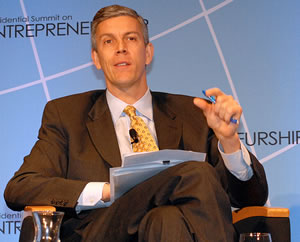
ED Secretary Arne Duncan said last month that the “gainful employment” rules were meant to ensure responsibility and honesty in recruiting students to attend popular for-profit programs.
Eleven percent of U.S. college students attend for-profit schools, and those students represent 43 percent of all student loan defaults, according to government statistics. The median loan debt of a for-profit student is $14,000, while most community college students don’t borrow any money for their education.
“These new rules will help ensure that students are getting from schools what they pay for: solid preparation for a good job,” Duncan said.
Officials from colleges with low student loan default rates also spoke at ED’s public hearing. Charles Modica, chancellor of St. George’s University in U.S. territory Grenada, said his school could be in violation of the proposed ED rules if students are expected to get a job in their profession soon after graduation.
A medical degree “doesn’t lead to gainful employment a day later.” Instead, students begin residency training after graduation, he said, and pay back interest only on their student loans until they get a full-time, well-paying job.
For-profit colleges took a public relations hit in August when investigators from the Government Accountability Office (GAO) posed as college students and found that four out of 15 institutions they examined “encouraged fraudulent practices” to secure federal student loans, and representatives from all 15 colleges “made deceptive or otherwise questionable statements” to the undercover students, according to a report published on the GAO’s web site.
Four of the GAO investigators who went undercover and applied to for-profit schools were encouraged by college personnel “to falsify their financial aid forms to qualify for federal aid,” according to the report. In one case, a college recruiter encouraged the undercover applicant to hide $250,000 in savings so he would be eligible for federal student aid.
In an undercover video posted alongside the GAO report, a recruiter in Texas tells a pretend applicant that the government doesn’t “need to know how much cash you have” after the applicant said he received a $250,000 inheritance from a deceased aunt.
The GAO video also catches a California recruiter for a for-profit school urging an applicant to increase the number of dependents in his household so he can qualify for Pell Grants.
- Research: Social media has negative impact on academic performance - April 2, 2020
- Number 1: Social media has negative impact on academic performance - December 31, 2014
- 6 reasons campus networks must change - September 30, 2014
Comments are closed.