
Key points:
- AI should be viewed less as the competition and more as part of the curriculum
- What “friction maxxing” teaches us about IT skill development in the age of AI
- AI is reshaping entry-level work and the talent pipeline
- For more news on AI’s role in IT careers, visit eCN’s Teaching & Learning hub
The Washington Post recently published an article saying that, for the first time in 20 years, enrollment in computer science college majors is down. For the last two decades, that major has been one of the most popular at any school.
The decline is significant, but it’s not really a surprise. Students are understandably worried about negative news. The headlines are saying AI is replacing all the entry-level jobs, and the news is full of big tech’s massive layoffs. If you’re a student considering an IT-related career, it would be easy to look at that picture and wonder whether you’re walking into the right room at the wrong time.
The fear is understandable. However, there’s a lot more behind the headlines. According to CompTIA’s recent analysis, new tech job postings recently hit a three-year high, and roughly 20 percent of those active tech job postings are still aimed at candidates with zero to three years of experience.
The opportunities haven’t disappeared. What has changed is what employers expect from entry-level candidates. As schools prepare students for careers in technology, that distinction matters.
The opportunity is still there
The layoffs happening at large tech companies are real, but the story behind them is more complicated than the headlines suggest. Some organizations that reduced headcount in favor of AI-driven automation are now rehiring for similar roles after discovering something important: AI still requires human oversight. It needs people who understand how it works, where it fails, and how to use it effectively in a real workflow.
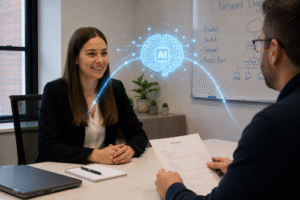
For educators, this means AI should be viewed less as the competition and more as part of the curriculum. Employers increasingly value candidates who understand the fundamentals behind AI systems – not simply how to use the latest tools. Helping students develop that foundational understanding is becoming an important component of career preparation.
What “AI-literate” means
A few years ago, familiarity with AI tools was a nice-to-have on a resume. Today, it’s closer to a baseline expectation in many IT roles. The gap between candidates who have it and candidates who do not is widening quickly.
AI literacy doesn’t necessarily mean knowing every platform or passing a specific certification. It means understanding the underlying concepts well enough to apply them intelligently, to recognize when a tool is producing unreliable output, and to make judgment calls that a model can’t make on its own. Employers increasingly recognize the difference between candidates who can simply use AI and those who can think alongside it.
This shift presents an opportunity for schools to move beyond teaching tools alone and instead emphasize critical thinking, problem solving, and the responsible application of AI technologies.
Knowing and doing
Technical knowledge matters, but the ability to apply that knowledge remains the biggest differentiator for students entering the IT workforce.
Hiring managers in IT aren’t making decisions based on transcripts. They’re looking for evidence that a candidate can do the work. Lab environments, home projects, certification exam scores, and real-world problem-solving scenarios all tell a more compelling story than coursework alone. The candidates who stand out in today’s entry-level market are the ones who have the skills and can show their work, not just describe it.
This is one reason hands-on training programs have become increasingly valuable. An employer reviewing two candidates with similar backgrounds will consistently favor the one who can walk through a real scenario, explain their reasoning, and demonstrate that they have actually built or broken something in a lab environment.
Four ways schools can prepare students
As technology careers continue to evolve, schools can help students remain competitive by emphasizing a few key areas:
- Build foundational knowledge, not just tool familiarity. Help students understand how systems and technologies work beneath the surface so they can adapt as tools continue to evolve.
- Prioritize hands-on learning. Labs, simulations, home projects, and industry-recognized certifications give students opportunities to demonstrate practical skills—not just theoretical knowledge.
- Integrate AI literacy throughout IT instruction. Students should understand where AI adds value, where human oversight remains essential, and how to use these technologies responsibly.
- Foster a mindset of continuous learning. The technology professionals employers value most are those who continue developing their skills long after graduation.
The IT job market in 2026 isn’t the same one that existed five years ago, but it’s also not as bleak as many headlines suggest. The opportunity remains very real for students who graduate with the right combination of technical knowledge, practical experience, and AI literacy. By adapting curriculum to reflect changing employer expectations, schools can help ensure students enter the workforce prepared to succeed in today’s IT environment.

James Atria is Senior Live Online Lead Instructor at MyComputerCareer, specializing in IT education and technical training. He leads and develops instructors while delivering hands-on training in networking and cybersecurity, fostering a fast-paced, results-driven environment focused on student success.
- 5 leadership priorities to become AI-ready - October 9, 2026
- Learner agency comes first in AI-driven digital literacy - October 7, 2026
- Authority, responsibility, and accountability for AI in higher ed - October 5, 2026