

How does this complexity impact engineering education? In a complex system, learning how all the pieces – constant and variable – interact gives a depth of understanding that averts catastrophe. That is what we mean by human-centered design – understanding the interfaces among technology, people, communities, governments and nature. This is what makes complexity manageable. All complex systems have, as a foundation, fundamental principles or core knowledge that cannot be ignored.
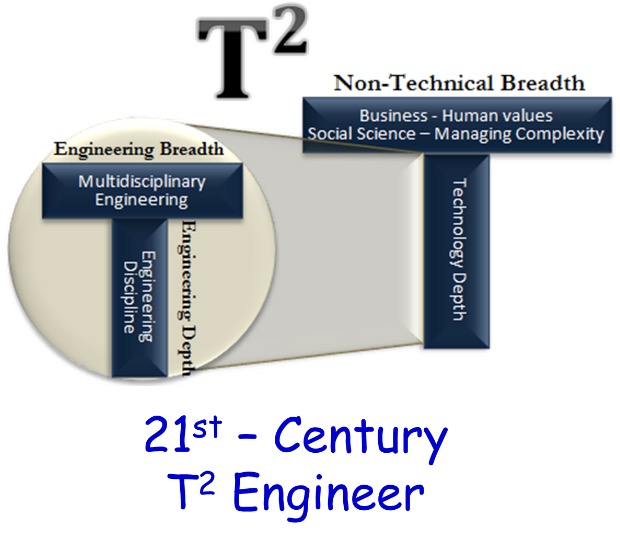
However, there must also be a flexibility from the engineering perspective to respond to problems that inevitably arise. Clearly, the typical discipline-specific engineer is not well-equipped to manage such complexity; not even an engineer with multidisciplinary engineering breadth can do an effective job. Complexity demands an engineering skill set with technology depth and also non-technical breadth—specifically, human-centered design expertise capable of managing complexity. Complexity demands a T2 Engineer, as the diagram shows.
Why are these engineers not being created, and how do we ensure that they will be created? The urgent problems society faces are multidisciplinary in nature, complex, and ever-changing.
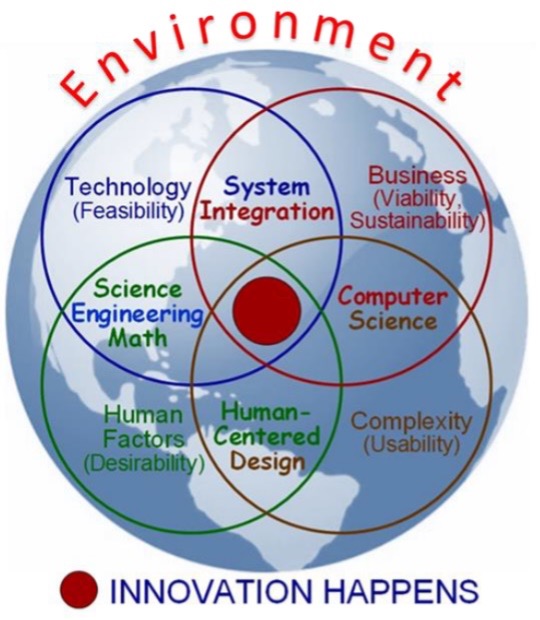
Engineering graduates need to be able to adapt and apply technology that is human-centered, desirable, feasible, viable, sustainable, usable, and manageable, as the innovation diagram shows:
Incoming students need to experience a culture change. They need to transform from the world of memorizing, test-taking, and focusing on grades to the world of critical-thinking and problem solving, turning easily accessible information into insight and understanding, and taking responsibility to become an engineer. So, if we all know what should happen in engineering education, why is it not happening?
As I see it, there are two main impediments to engineering education reform. First, the silo structure in a typical engineering college does not foster reform. Engineering departments typically don’t collaborate or interact in a multidisciplinary way and fail to realize that doing so would enhance, not diminish, what they do. Second, there is a failure of faculty to get out of their comfort zone, i.e., a failure to become comfortable being uncomfortable, become involved in real-world problem solving, and to respond to the challenges of teaching multidisciplinary engineering problem solving in an integrated, discovery-learning mode.
Knowledge in engineering education needs to be unbundled and rebundled to integrate it all, give it balance between theory and practice, and give it relevance to the solution of the multidisciplinary problems society faces. Engineering education done in this manner can mitigate catastrophe!
Related:
Engineering education is broken

Kevin Craig is Professor of Engineering at Hofstra University.He was a Professor at Rensselaer Polytechnic Institute (1989-2007) and the Greenheck Endowed Chair in Engineering Design at Marquette University (2008-2014).He is a graduate of Xavier HS in NYC, the U.S. Military Academy at West Point, and Columbia University.
- College was the default answer, but the data says it’s time to ask better questions - October 26, 2026
- The most advantaged students attend the best-funded colleges. Does it have to be this way? - October 23, 2026
- Here’s what happens when colleges make the SAT optional - October 19, 2026