

The new report inspected another factor: common courses completed by students enrolled in a certain capstone. By knowing which classes the students bring (or are missing), the instructor can further tailor his or her multidisciplinary approach by building off of stronger disciplines and providing more focus in weaker areas.
Here’s a sample snippet of the new report emailed to the capstone instructor. In this case, 15 students in the class had previously taken PSY*111.

As one faculty member said, “I was stunned that nearly every student in my class had taken economics during the completion of their core requirements. As a result, I invited an economics professor to join me in a discussion on the impact of tariffs on the global economy.”
Similarly, another professor wrote, “I was surprised that students in my course that had managed to avoid history completely would register for a course titled Rome!”
Expanding the Registrar’s outreach
Given the success of the initial trail, the Registrar’s Office began to work with faculty to determine other information that could be provided to positively impact the pedagogy of a course. Some ideas include:
- current technologies being used outside the classroom
- the types of direct service that has been performed
- global education experiences
- languages taken
- whether the learner considers themselves an introvert or extrovert
- the country/region they are from
Some of this information is available in the student system, but some will need to be collected. To accomplish this, we will survey all students at the beginning of each fall using Colleague, our student system.
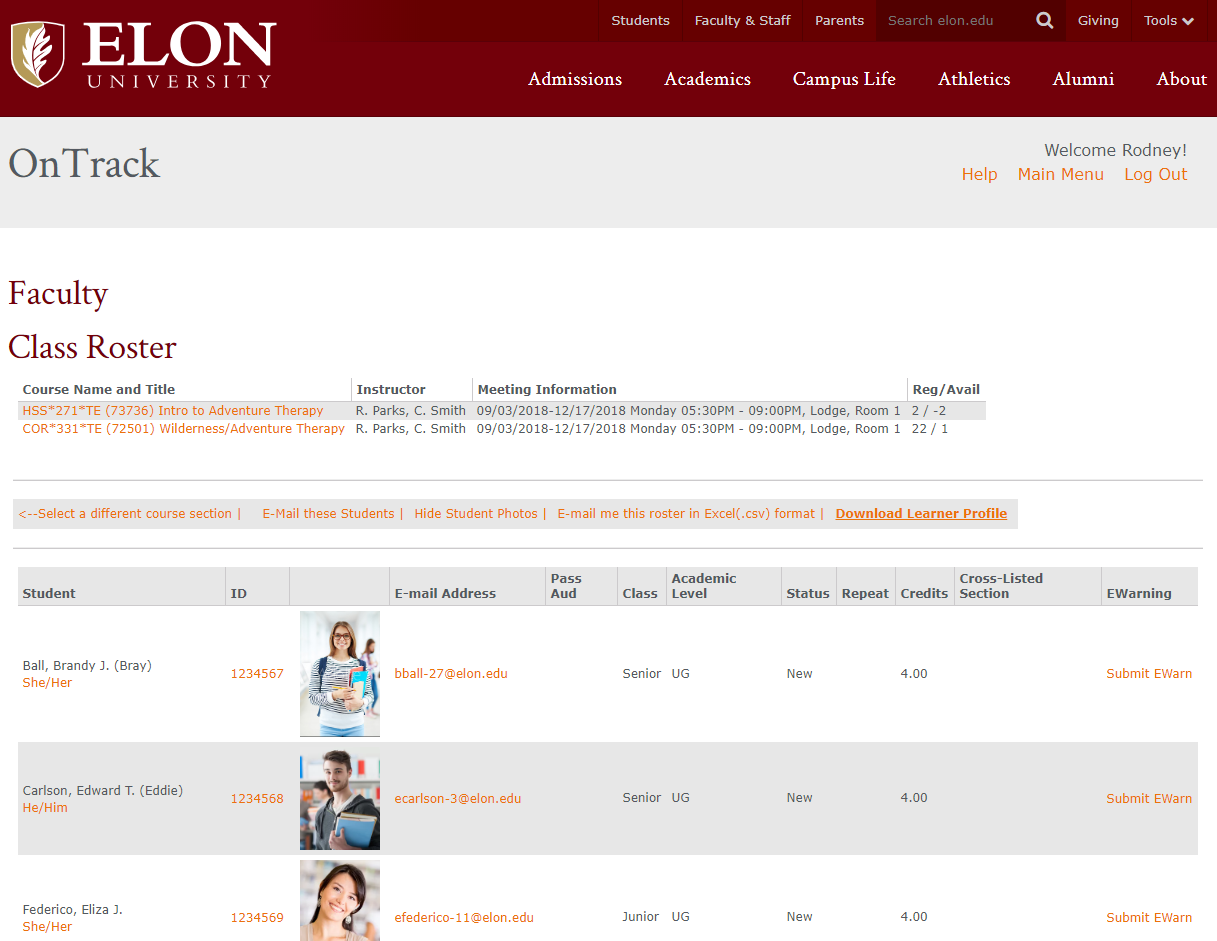
The new “Learner Profile” will be available for download from the faculty members’ class roll each semester (see below). Initially, the profile will be standardized across the institution, but future iterations could be based on declared major.
Throughout primary and secondary schooling, teachers spend time getting to know their students. For those of you reading this that occasionally teach, consider the questions that we frequently ask a new class: Why are you taking this course? What do you hope to learn? What have you heard about the course? These questions tells us little about our students.
Having a learner profile could help students engage more quickly, feel connected, and open the door to sharing more about who they are as adult learners.

Dr. Rodney L. Parks is the registrar, director of Summer College, and special assistant to the provost at Elon University where he has served since January 2013. Dr. Parks also serves as an assistant professor in the Human Services Science Department. Parks earned his Ph.D. in Counseling from the University of Georgia and has published numerous research studies and book chapters focusing on the unique populations of students navigating higher education.
Casey Hayes is an assistant registrar for data management and reporting at Elon University, where he has served since 2013. Hayes earned a BS in Computer Science from Elon University. Besides his work on a number of big data initiatives, he serves as team of innovation for Elon’s student system, Ellucian Colleague.
- 5 best practices for building a university-wide model for online enrollment growth - November 2, 2026
- The data retention challenge for online exam platforms - October 28, 2026
- College was the default answer, but the data says it’s time to ask better questions - October 26, 2026