
Key points:
- Strong AV systems are often a make-or-break for students and faculty
- What’s the state of wireless in higher education?
- Rising cyber threats drive higher-ed leaders to prioritize cyber resilience
- For more news on IT infrastructure, visit eCN’s IT Leadership hub
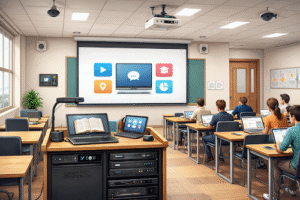
Today’s students and faculty expect seamless technology experiences on and off campus–and a new study reveals that poor technology can prompt students and educators to think about changing institutions.
A survey of students and faculty at higher education institutions, conducted in June 2025 by Logitech and AVIXA, highlights the negative impact of poor AV technology on student and faculty retention and satisfaction.
One in three faculty and one in four students said they have considered changing institutions due to poor technology experiences. Fifty percent of faculty members said they have AV challenges daily or weekly.
Fifty-one percent of students consider hybrid courses when they are choosing an institution.
The right AV choices help boost student and faculty satisfaction, prevent retention drain, and improve reliability and ROI.
Top barriers to strong technology and AV experiences include having to use unreliable systems to deliver engaging lessons and losing learning time due to tech tool failure.
Faculty struggle with hardware malfunctions (77 percent), video conferencing failures (66 percent), and software access issues (66 percent).
Students struggle with log-in challenges (66 percent), connectivity disruptions (61 percent), and software access issues (52 percent).
Seventy-three percent of higher-ed IT leaders say faculty satisfaction is the top metric by which they measure success. Eighty-two percent of surveyed colleges and universities have AV upgrades planned, while 65 percent are modernizing outdated rooms instead of replacing technology.

- Weak tech could push students, faculty to other institutions - April 13, 2026
- 13 predictions about edtech, innovation, and–yes–AI in 2026 - January 1, 2026
- 5 essential dimensions of AI literacy - December 12, 2025