
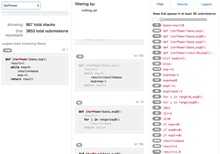
Online homework system clusters similar student programs together, so instructors can identify broad trends.
In computer-science classes, homework assignments consist of writing programs. It’s easy to create automated tests that determine whether a given program yields the right outputs to a series of inputs.
But those tests say nothing about whether the program code is clear or confusing, whether it includes unnecessary computation, and whether it meets the terms of the assignment.
Professors and teaching assistants review students’ code to try to flag obvious mistakes, but even in undergraduate lecture courses, they usually don’t have time for exhaustive analysis. And that problem is much worse in online courses, with thousands of students, each of whom might have approached a problem in a slightly different way.
In April, at the Association for Computing Machinery’s Conference on Human Factors in Computing Systems, MIT researchers will present a new system that automatically compares students’ solutions to programming assignments, lumping together those that use the same techniques.
(Next page: In-depth detail about how the system functions)
 Laura Ascione is the Editorial Director at eSchool Media. She is a graduate of the University of Maryland's prestigious Philip Merrill College of Journalism.
Latest posts by Laura Ascione (see all) - Weak tech could push students, faculty to other institutions - April 13, 2026
- 13 predictions about edtech, innovation, and–yes–AI in 2026 - January 1, 2026
- 5 essential dimensions of AI literacy - December 12, 2025
- Weak tech could push students, faculty to other institutions - April 13, 2026
- 13 predictions about edtech, innovation, and–yes–AI in 2026 - January 1, 2026
- 5 essential dimensions of AI literacy - December 12, 2025