
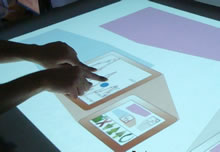
The software that enables users to connect these displays online is IP-based and can be used for real-time interactive updates, “so if someone moves a graphical object here at Purdue, the software will transmit this move to Manitoba, and they will see the object move there,” says Elmqvist.
Future iterations might allow the connecting of mobile devices as well, which could be useful in emergency situations, Elmqvist says.
For instance, firefighters might create a command center where they have a tabletop display on which they deploy their various teams across a variety of locations. The responders in the field could connect on their smart phones and see where the people in the command center are deploying them, or whatever else the commanding officer wants them to see.
The Purdue and Manitoba researchers plan to offer the technology—dubbed Hugin, for the raven in Norse mythology that acted as the eyes and ears of the god Odin—to other researchers and developers free of charge.
They expect to make the software available online at the project’s website soon.
Collaboration leads to learning
The collaborative capability of the technology, which allows a large number of people to gather around the tabletop displays in two separate locations and to interact with the content on the tabletop and with each other, is perfect for an educational environment.
“You can have several people working around the table at the same time, and you could have an instructor located somewhere else with his own tabletop,” Elmqvist says.
Schools that can’t afford to have a specialized teacher on campus, for example, could use the technology for distance learning. Other educational applications might include connecting groups of students at different universities for collaboration on a single project.
Elmqvist and his team are currently working on an educational deployment in a children’s museum in Indianapolis.
The application will be a city simulation that will allow users to move Monopoly-like pieces to build a city, complete with houses, roads, cars, people, buildings, and shopping centers, and see what happens with the environment as a result.

- Here’s what happens when colleges make the SAT optional - October 19, 2026
- What small models teach - October 16, 2026
- Graduates and employers differ on career preparedness - October 14, 2026