
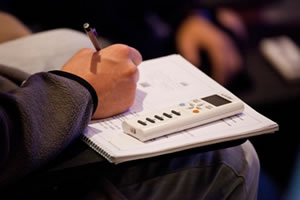
Loving said some of the most divisive issues addressed in his Family Relationships class – a course he has taught for seven years – include same sex marriage, corporal punishment, and the decision to have children.
Giving students clickers during question-and-answer sessions, he said, has “promoted more honest discussion” with students who often hesitate to answer honestly during lectures that focus on “potentially contentious” social issues.
“I used to really have to draw the answers out of some students,” Loving said, adding he became familiar with timid students’ tendencies before he used student response systems. “Students can be fairly sheepish about some issues. … I could always see them sort of slink down in their desks” when hands were raised to answer Loving’s questions.
Higher education officials have welcomed student clickers into classrooms and lecture halls since the devices became commonplace on campuses in the mid-2000s.
Students who used clickers to answer questions during physics lectures scored an average of 10 points higher on their final exam when compared to students who didn’t use the response system, according to a 2008 Ohio State University study, which was first published in the American Journal of Physics.
Using clickers during lectures also evened test scores in the Ohio State study. In a class that didn’t use clickers, male students outscored female students. Scores were almost equal in the class that used clickers, according to the university’s research.
Professors and instructors who use student response systems spend 20 percent of class time with clickers; the rest is used for traditional lectures.
College students have also embraced clicker systems. Most students who participated in a clicker study at a small Midwestern university in 2007 said they would recommend using clickers in the classroom, according to research conducted by Margaret Martyn, an assistant dean at DePaul University.
“Contrary to expectations, learning outcomes of students using clickers did not improve more than the traditional active learning approach of using class discussion,” Martyn wrote in her conclusion. “Perhaps the value of the active learning pedagogy outshadowed the benefit of using clickers.”
- Research: Social media has negative impact on academic performance - April 2, 2020
- Number 1: Social media has negative impact on academic performance - December 31, 2014
- 6 reasons campus networks must change - September 30, 2014