
We use a cycle that we call the F-I-A process: foresight to insight to action (see figure 1). We believe that any successful strategy is based on a good insight about the future. So, as you think about the future and consider the tides—that is, as you develop foresight—ask yourself a question: What does it mean for us? What’s the insight? The same foresight, the same possibility, or the same tide may offer very different insights depending on your type of industry or organization. For example, if we’re moving to a new way of accreditation or credentialing, one very different from traditional degrees, the insights will likely vary depending on your institution. Ultimately the goal is to use this foresight and the resulting insight as a way to determine the action to take. Although the foresight is usually five to 10 years out, the action may be needed today or six months from now. What do we need to do today or tomorrow to either prepare for that future or to shape it in a more desirable direction?
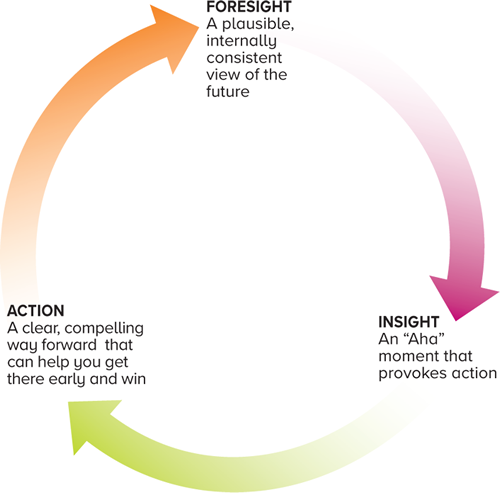
Source: Institute for the Future, 2007
#2: Focus on signals
What tools do we have to help us systematically think about the future and develop foresight? There is no data about the future; all the data we have is about the past. Historical data is useful when things continue as they are. You can just continue planning for the same trajectory. That’s fairly easy.
The situation is different when things are changing and there are inflection points. I think we are in this space right now: notions of what learning is, how and where people learn, and the value of degrees and who grants degrees are all changing. What tools do we have to help us think about the future in this landscape? At the Institute for the Future, we use what we call signals of the future to help us develop foresight.
The science fiction writer William Gibson famously said, “The future is already here, it’s just not very evenly distributed.” Indeed, signals of the future are all around us today. Often these are things or developments that are on the margins. They may look weird or strange. They are the kind of things that grab your attention and make you ask: “Why is this happening? What is going on here?” A signal can be anything. It could be a technology, an application, a product/service/experience, an anecdote or personal observation, a research project or prototype, a news story, or even simply a piece of data that shows something different. Recently I read that 62 percent of jobs today do not afford people with middle-class livelihoods. For me, that was a signal. Unemployment is low, and the economy is booming. What is going on here? A signal is anything that makes you want to dig in and say: “Why? What is causing this situation?”
Let’s take as examples an old signal and a new signal. In 1995, eBay first appeared on the horizon and created a lot of excitement. Strangers began to trade with each other. You trusted somebody you’d never met to sell you something, and you agreed to pay them! The significant signal here, the critical innovation of eBay, was the creation of a reputation system, for both the seller and the buyer. The creation of this online reputation system enabled strangers to conduct economic transactions easily. This idea could be carried into many different arenas, and it was. Today, all online transactions rely on some sort of a reputation system. Online reputation has become a new kind of currency. When I was a child, we were told: “Don’t get into cars with strangers.” Now most of us don’t think twice about getting into Uber or Lyft cars with complete strangers. So, this signal, this notion of online reputation markets, changed the whole industry, allowing new kinds of transactions in which strangers come together. Just a few examples are Uber/Lyft, Upwork, LinkedIn, and the whole ecology of badges certifying that someone has certain skills or abilities.
That’s the old signal. An example of a new signal is a video billboard in Sweden. It’s placed at a bus stop. If somebody at the bus stop starts smoking, the billboard plays a video of a person choking. What this signal shows is that what used to be on our laptops and desktops—all of this information, all of this content—is moving into the real world. It will become available not just on billboards but all around us. We’ve talked about how the whole world can become infused with media, and that has happened. We can access content almost anywhere and interact with it.
If you are a futurist, you will get into the practice of looking for signals all the time. When you wake up in the morning and read the news, you will look at everything through the lens of these signals. You will naturally ask about events: “Is this a signal of something? Why?” This kind of curiosity and the ability to continually sense while also sharing with others is very important.
Ideally, people in organizations will think about signals and get together to share their observations. I call this sensing. To be a sensing organization, staff need to create some means, formal or informal, of aggregating these signals and working to interpret them. This will allow feedback and direction on what to do next.
#3: Look back to see forward
I said earlier that there is no data about the future; the only data we have is about the past. While we cannot fully rely on past data to help us see the future, there are larger patterns in history that we tend to repeat over and over again. Thus, we need to look back to see forward. I’ve started to think of myself as a historian as much as a futurist. I’m trying to understand the larger story and to place what is happening today and what we see on the horizon into a larger context. We don’t repeat our history completely, but we do repeat patterns. If we look at the invention of the printing press and the debates and worries that people had at that time, we see that those concerns are very similar to our current debates and worries about fake news, computational propaganda, bots and how they skew our public opinion. It’s almost eerie. People were talking about fake information and propaganda and lies all those years ago!

Marina Gorbis is executive director of the Institute for the Future. She is the author of The Nature of the Future: Dispatches from the Socialstructed World.
- To rebuild adult learner confidence, universities must first earn their trust - August 24, 2026
- Schools are building AI rules before they know the destination - August 17, 2026
- Cohort connections matter: Strategies to help graduate students persist and succeed - August 14, 2026