
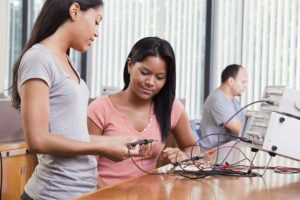
Outside of comparing astronomy to robotics, here’s how other STEM subjects rated on the gender engagement scale, according to Piazza’s data [Ordered from lowest confidence gap for women to highest confidence gap for women.]
- Astronomy/astrophysics
- Accounting/finance
- Economics
- Business
- Psychology
- Mathematics
- Electrical/computer engineering
- Biology
- Physics
- Aerospace/mechanical engineering
- Statistics/probability
- Chemical engineering
- Civil/environmental engineering
- Computer Science
- Bioengineering
- Robotics (Robotics has the biggest confidence gap between men and women in answering questions, says Gilmartin.)
“We need to look at data like this because it’s important to understand that the culture of a class or field is just as important as what’s being taught,” she explained. “Not only is the implementation of an online component of the class critical for students who may not feel as confident participating in class, but curriculum design and engagement tools are also an integral part of attracting women to diverse STEM fields.”
Gilmartin continued, adding that “there needs to be so much more than just a lecture, since that type of ‘traditional’ learning environment is not supportive of students who may feel intimidated during class.”
Piazza’s data also looked at which colleges and universities currently do a great job of engaging women in STEM classes, as well as which ones could use improvement:
- One of the few schools where women answer more questions than men in both STEM and computer science is Penn State.
- At Duke University, women tend to answer more questions than the average in both STEM and CS. In CS, they actually answer questions at a lower anonymous rate than men. In STEM, they answer questions at a much higher anonymous rate than men.
- At MIT, women have an average confidence level in CS, but are more confident than the average in STEM.
- However, women are “much less confident” in both STEM and CS at Carnegie Mellon University and Cornell University.
- And at Princeton University and Columbia University, women are “way less confident than the average” in STEM.
For more information on Piazza’s research, as well as to request data sets, contact here.
- 25 education trends for 2018 - January 1, 2018
- IT #1: 6 essential technologies on the higher ed horizon - December 27, 2017
- #3: 3 big ways today’s college students are different from just a decade ago - December 27, 2017