

Artificial intelligence can automate parts of the instructional process, but its greater promise is to extend the instructor’s reach rather than replace the instructor. The central question is how AI-supported environments can strengthen learner agency through individual pacing, timely feedback, and meaningful opportunities to demonstrate mastery. In Introduction to Computing at the College of Southern Nevada, I pursued that question by developing browser-based courseware centered on mastery, immediate feedback, and authentic application. Expertise in digital literacy, AI literacy, and instructional design shaped its goals, content, assessments, feedback, and progression rules. AI helped translate those decisions into a working application and also became an object of critical inquiry for students.
Guided by these priorities, the self-paced environment combines behaviorist reinforcement, cognitivist organization, and constructivist application while reducing dependence on commercial textbooks and media. This practice-based article examines the project’s rationale, development process, guiding principles, and broader implications. Its central argument is that AI contributes most when instructional design directs the technology and automation supports, rather than replaces, purposeful teaching and learning.
Later reporting on a Harvard physics study offers a useful point of comparison. Researchers created an AI tutor from instructors’ lesson plans and compared it with active-learning classroom sessions in a randomized trial. Students using the tutor reportedly achieved greater learning gains in less time and reported higher engagement, outcomes the researchers attributed to immediate feedback and individualized pacing rather than to software replacing instructors. Although I encountered this reporting after developing the courseware described here, the findings parallel the principles that guided my design.
Rethinking a Familiar Course
Those principles took shape in Introduction to Computing, a high-demand course serving students across majors and appearing as a requirement or elective in more than 50 degree programs. Because students enter with widely varying experience, the challenge was not simply to introduce software features but to build demonstrable, transferable competence while incorporating AI literacy into a rapidly changing curriculum.
The opportunity was to design a learner-focused, self-paced, browser-based courseware application and use AI to help implement that design as both a development tool and a learning platform. Students move through four units, practice individual skills, and receive immediate automated feedback on most procedural work. The units address foundational AI literacy, Microsoft Word, Microsoft Excel, and AI-assisted presentation design. The redesign was neither a transfer of lectures into an online shell nor a duplication of a commercial product. Instead, it was a purpose-built learning environment shaped by instructional goals and local student needs.
Creating original materials and curating learning resources required substantial time, synthesis, and analysis, but subject-matter and instructional-design expertise made the work manageable. Publicly available resources also helped. One particularly valuable discovery was that local public library members have access to LinkedIn Learning. Its extensive collection of high-quality videos provided many options for targeted learning support. Students appreciated using these resources as needed and were surprised that library membership provided access to a platform the college does not offer. Many said they planned to use it in other courses as well.
Faculty Participation and Adoption
AI literacy and digital literacy are now inseparable, creating an urgent need for new learning pathways. The project was largely a solo effort because many instructors were not yet ready to use AI in teaching and learning. While educational leaders often focused on policies and syllabus statements rather than AI’s instructional challenges, I drew on my experience as an innovator and early adopter. Of the five full-time professors teaching the course, including me, only one colleague accepted my invitation to participate. My primary goal was to design an environment that approximated individualized instruction by placing personalized learning and feedback at the center; AI supported implementation of that design. Developing courseware specifically for our students was especially appealing because commercial products typically require instructors to adapt rigid, standardized content to local needs, often with an imperfect fit. I wanted to move beyond that compromise as definitions of digital literacy evolve and AI concepts change rapidly. Equally important, the zero-cost courseware saves each student up to $159; broader adoption could improve affordability and reduce barriers to access across the community-college population. Treating affordability as a design requirement reinforces the principle that instructional priorities, not technology alone, should shape the learning environment.
Dr. Arthur Salmon was the only other full-time professor to join the development effort, drawn by the opportunity to explore new approaches, reduce student costs, and improve course quality through innovative instructional design. Although I had hoped for broader faculty participation, limited involvement was expected because transformational change typically attracts few early adopters. If turning an aircraft carrier takes miles, changing established teaching practices can take even longer. Adjunct faculty have expressed greater interest, perhaps because of their industry experience, AI fluency, and awareness of AI’s growing importance. Given the strong student response and the likelihood that students will share their experiences, I expect faculty interest and AI integration to grow through necessity and intellectual leadership rather than through administrative pathways.
Starting with Learner Agency
The redesign begins with the central idea of learner agency: the student’s ownership of learning. That principle became more important as generative AI has made it increasingly difficult to infer learning from the polished appearance of a finished product. A fluent paragraph, attractive slide deck, or plausible spreadsheet may now conceal weak understanding. Consequently, the course does not define digital literacy as access to tools. It defines it as the capacity to act, verify, judge, and explain.
This emphasis shaped several practical decisions. Students can work asynchronously and at their own pace, but progression is not passive. In the Word and Excel units, they must complete each skill check before the project area unlocks. They receive repeated opportunities to practice without penalty, yet they cannot bypass the evidence of mastery that prepares them for comprehensive projects. In the AI units, they must inspect and evaluate generated work rather than treat output as authoritative. No single answer or pathway defines proficiency in these intentionally ill-structured tasks. Agency in this design therefore combines meaningful learner control with responsibility.
Building a Skill Architecture as a Foundation
I aligned the procedural curriculum with external industry standards rather than relying solely on an instructor-created skills inventory. Benchmarking objectives and outcomes is a high-value instructional-design task, so Microsoft certification exams provided a useful framework. The goal was not to create a test-preparation course, but to ensure that students gained knowledge and transferable skills that would support both their academic work and future pursuits.
I designed a consistent learning cycle for each of the 157 skills. Every skill card presents a focused task with concise instructions, a brief explanation, and a targeted video segment. Students complete the task and submit their work for automated evaluation; a correct result immediately updates the skill status and progress indicator. They may repeat the cycle as often as needed, but the related projects remain locked until every skill in the unit has been verified. Green check marks and advancing progress bars reinforce achievement and build readiness for more complex projects. Students reported feeling both excited and prepared to demonstrate their expertise.
Multimedia support requires careful curation. I matched each skill with a relevant segment drawn from approximately 154 LinkedIn Learning videos across six courses. Instead of assigning hours of required viewing, each skill links directly to the appropriate section and timestamp, reducing the search burden for novices and providing focused support for the task at hand. This microlearning approach uses chunking and scaffolding to build mastery. Because not every student needs a demonstration for every skill, videos remain optional and responsive to individual needs. Learners may instead consult written materials, user guides, websites, or AI tools, selecting the format and level of support that work best for them. Students repeatedly reported that these choices were both helpful and motivating. This flexibility reinforces learner agency.
Through repeated testing and refinement, the AI platform translated my instructional design and specifications into a working application that closely matched my vision.
From Practice to Authentic Application
Practice checks provide formative assessment of individual skills, while ten capstone projects serve as summative assessments that require students to integrate those skills in authentic academic and workplace contexts. The projects include an annual report, an employee training manual, a sociology research paper, an event proposal, an IT Help Desk knowledge base, a campus-newsletter editorial review, a client-billing analysis, a healthcare staffing plan, a course-grade analysis, and an event inventory and budget. These locally relevant scenarios connect course concepts to realistic applications rather than to conventional, didactic assignments. Students reported that the project themes increased both their engagement and their motivation.
A Deliberate Blend of Learning Theories
The course integrates multiple learning theories rather than forcing instruction into a single framework. Selecting the appropriate approach was an instructional-design decision that preceded implementation; AI-assisted development then translated those decisions into courseware features. Immediate feedback, visible completion cues, repeated practice, and mastery gates apply behaviorist principles by reinforcing specific actions. Domain organization, staged sequencing, worked examples, and coordinated verbal and visual instruction reflect cognitivist attention to schema development, working-memory limits, and cognitive load. Authentic projects, student choice, open inquiry, and reflective AI assignments draw on constructivist principles by engaging learners in meaningful problems. Instructional methods should therefore match the nature of the learning rather than conform to one theory or technology. Instructional design, not technology, should guide the process. AI is not a solution looking for a problem, but it can help implement a carefully designed response to an instructional need.
Teaching AI by Requiring Verification
Rather than portray AI as a shortcut or ban it as a threat, I required students to evaluate it critically. Because generative AI can present inaccurate information confidently, AI literacy requires students to identify credible sources, compare evidence, inspect outputs, and exercise independent judgment rather than accept results as authoritative. Effective use also depends on foundational knowledge: students cannot recognize errors or assess quality without understanding the subject. Although AI enabled new forms of learning and course design, it was not intended to replace instructor feedback, especially for work requiring nuanced reasoning and analysis. The goal is not merely to teach students to use AI tools, but to help them verify outputs, recognize limitations, and remain responsible for their conclusions. At its foundation, AI education is therefore independent of any platform or tool.
Design Lessons and Implications
Immediate feedback is effective only when grounded in reliable, instructor-defined criteria. AI supported interface implementation, but the greater challenge was defining success and designing appropriate automated checks and responses. Feedback, assessment, and software development therefore became inseparable because every automated task embodied an instructional judgment about the skill or concept being evaluated. Whether support comes from an integrated AI feature, an automated grader, a video, an explanation, or guided questions, its design requires thoughtful planning, iterative development, and rigorous testing. Instructors must also determine when to use generative AI and when retrieval-augmented generation (RAG) is more appropriate, while teaching students to use both responsibly and effectively. These capabilities are among the most important students need today.
Self-paced learning still requires clear structure, sequencing, feedback, and accountability. Mastery gates provide that structure while accommodating different rates of progress: experienced learners can demonstrate familiar skills quickly and advance to more complex work, while novices can practice repeatedly and draw on multiple forms of support. The course allows flexibility in pacing, not in standards. Because many students work during evenings and weekends, when instructors may be unavailable, continuous access to guidance and feedback is especially valuable. Greater control over learning, particularly timely help with questions, can strengthen persistence, motivation, and performance. I designed the course’s AI support to function as a Socratic guide, and AI implemented that approach through progressive hints and questions rather than by supplying answers. This design helps students reason toward their own solutions, preserving learner agency while providing timely, individualized support.
Just as no single instructional approach fits every learner, no single use of AI fits every learning need. Some feedback, discussion, and reasoning still benefit most from direct instructor involvement, although AI grounded in instructor-curated information, such as retrieval-augmented generation systems, can provide valuable support. I chose to preserve human feedback where I considered it most instructionally valuable, even when substantial automation was possible. AI can provide extensive feedback and cognitive support, but it should complement rather than replace the instructor. Its greatest promise is as a cognitive partner for both instructors and students.
An important consideration is how students responded to the design and whether their experiences suggested improved learning. Dr. Arthur Salmon observed growth in students’ problem-solving and critical-thinking skills, which he associated with the range of learning resources built into the courseware. Students sometimes emailed about a problem and then followed up minutes later with, “Please disregard; I figured it out on my own.” Although anecdotal, these moments suggested greater persistence, independent problem solving, and confidence.
Conclusion
The redesign demonstrates how learner agency can be built into a course through defined skills and concepts, targeted multimedia support, mastery-based progression, authentic capstone projects, automated checks, and critical inquiry about AI grounded in evidence and judgment. Its primary innovation is the deliberate alignment of outcomes, practice, feedback, and assessment, with technology serving that instructional design.
In the AI era, course design must go beyond teaching students where to click or assuming that a polished product demonstrates competence. Students need opportunities to control the pace and pathways of their learning, practice to mastery, apply skills in meaningful contexts, and evaluate automated output without surrendering responsibility. Careful planning made those expectations concrete and achievable for beginning college students, while AI helped scale timely support beyond the instructor’s immediate availability. The instructor remains essential in defining standards, shaping feedback, and deciding where human judgment matters most. The value of AI lies in supporting learner agency and extending purposeful teaching under the direction of sound instructional design.
Although many tools could have supported this project, I selected the products below solely for practical reasons, not brand preference. Their inclusion does not constitute endorsement. To avoid any appearance of bias, I accepted no support or compensation from any vendor or institution and have personally paid all associated costs.
- Anthropic Claude for application development
- GitLab for managing code versions
- Render for application hosting
Examples of AI-Created Courseware: Instructional Design, Not Technical Expertise, as the Foundation
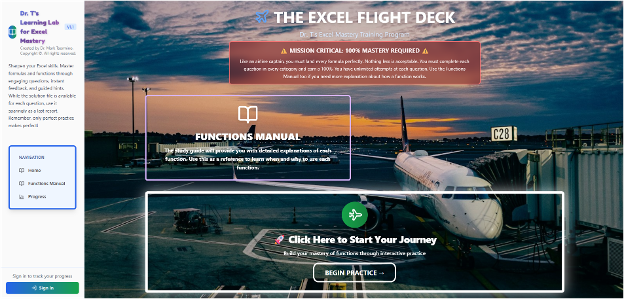
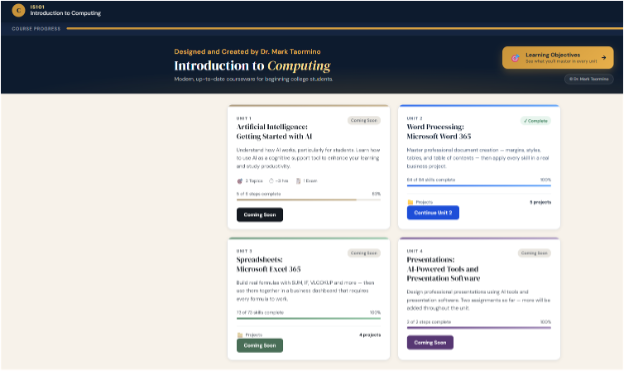

- Instructional design first: AI-assisted courseware for mastery and learner agency - November 6, 2026
- Weak tech could push students, faculty to other institutions - April 13, 2026
- 13 predictions about edtech, innovation, and–yes–AI in 2026 - January 1, 2026