
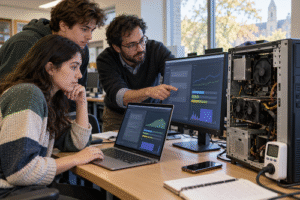
While investigating how to responsibly deploy generative AI at Haverford College, I have moved parts of my own AI workflow off commercial cloud platforms onto local hardware—my phone, work laptop, and an older desktop with a used graphics card. What began as an experiment has reshaped how I think about AI.
Small local AI models match their cloud cousins for many day-to-day tasks, and their limitations are plainly visible in ways frontier models’ limits are not. I find this suits my work style. And I am increasingly inspired by their potential as a tool for teaching critical digital literacy.
Listen to the press releases from the big two AI labs and you might think so-called frontier models are the sole locus of AI innovation. For example, on its release this September, OpenAI president Greg Brockman said of GPT-6 Astra: “It’s not unreasonable to feel that we are now in the AGI era.” Anthropic touts Fable and Mythos in similar terms. Frontier models are impressive. In fact, Claude helped me restructure this piece.
But they are not the only segment of AI that is rapidly advancing. A 27-billion-parameter Chinese open model that runs on a gaming PC now approaches the aggregate intelligence score of advanced cloud models in independent benchmarking site Artificial Analysis’s September 2026 rankings. Smaller variants that fit on a laptop can handle drafting, summarization, code review, and similar tasks at a quality that would have required the cloud in 2025.
Small models are not giantkillers. But almost no task requires gargantuan compute, end to end. Most quotidian work, even in higher education, is modular. Literature searches, copyediting, manuscript critiques, and logic checks can all start with compact LLMs, reserving frontier AI for the most challenging tasks.
Smaller models are my first stop for most literature searches. They excel at poking holes in my drafts, writing simple Python scripts, and delivering well-formed Linux commands. Research from 2026 finds that an LLM deployment that automatically escalates queries to a frontier model only when needed retains 97–99% of the frontier model’s accuracy. My own experience bears that out. I turn to cloud models when I need an AI that can conjure an app or give me a 360 critique of a near-final draft. For most tasks, the speed and convenience of local models wins.
Even more interesting, though, is small models’ jagged frontier. Cloud chatbots’ slick interface makes their underlying processes opaque. They invite users to treat generative AI as real magic when, in fact, it is stage magic—a highly precise set of mechanical processes that produce a superficially wondrous result.
Run locally, the grinding gears are apparent. Models with fewer parameters cannot bluff their way through tasks that are easy for humans but confoundingly hard for machines. They need external tools to do reliable math, and they still sometimes hallucinate authors’ first names when retrieving sources. Without enterprise support, fixing these problems is my job. I have learned to work within memory limits, manage context overflows, and decide between different quantizations—the mathematical tradeoffs that compress a model down to consumer size.
And that is the learning opportunity. Seeing the structural limits, and the surprising capability within those limits, can help us make better decisions about how we use it. Small models can also help us break through the stridency about generative AI that plagues too many conversations in higher education. Behind the curtain, AI is a spectrum of tools from tiny 0.5-billion parameter phone models to multi-trillion parameter frontier LLMs, accessible only in the cloud. Running one makes it hard to treat them as just one thing.
The nuance can inform teaching. Imagine an entrepreneurship course with a technical module in a campus computer lab. Students download an open-weight model, quantize it themselves at different precisions, and benchmark it on the lab’s hardware to see what each trade-off actually costs in speed, memory, and quality. They can see how an engineer might make a decision about which belongs in a new app, rather than relying on vendor marketing.
Imagine an environmental studies class that requires students to assess AI’s carbon footprint. Students use a Kill A Watt meter in the computer lab to find power draw, then design a method to compare their results with published energy figures for cloud models. Students might be disappointed by their answers. And that is the lesson.
Local models cannot replace institutional licenses for frontier AI services, but they can complement them. A campus-wide agreement allows colleges to vet tools for privacy and standardizes access. Likewise, local models allow students to experiment on a wide range of hardware, with the protection of knowing their data never leaves the machine.
For an individual, startup costs are surprisingly low. Open-source apps let users run small models without ever having to touch a command line. At the scale of a classroom activity, coordination with IT is a must. But that is an opportunity, too. For my own team at Haverford, visibility into how campus computing resources are used helps us budget. And clearly scoped student-facing projects build lasting collaborative relationships.
My own last few months of experimentation have convinced me that critical digital literacy requires seeing AI as more than one thing. Small local AI models highlight that multiplicity, stripping the polish that invites us to treat AI as a magic box, and showing us the technology beneath the hype. By revealing how the trick is done, they can help students make better decisions about when to use AI—or not—and which permutation of the technology best suits their needs.

Adam D. Zolkover is Director of Instructional Design and Technology Services at Haverford College, where—in addition to other duties—he works closely with faculty and senior staff to support and curate AI technologies in a way that aligns with the values of the institution. He is also an adjunct instructor at the University of Pennsylvania, where he has taught courses in folklore and digital culture.
- So, you want to be a school administrator? - November 4, 2026
- 5 best practices for building a university-wide model for online enrollment growth - November 2, 2026
- The data retention challenge for online exam platforms - October 28, 2026